Crypto products usually compete on visible things.
Speed.
Swaps.
Integrations.
Automation.
But once businesses begin using crypto operationally — for payments, settlements, contractor payouts, or treasury management — attention shifts toward something far less exciting: records.
Transaction history, receipts, reporting, exports, and audit trails rarely appear in marketing campaigns, yet they are some of the most important features for real-world adoption.
Once crypto becomes part of a company’s workflow, businesses stop asking, “Can this move money quickly?” and start asking: “Can we track, verify, and report everything properly?”
Why Reporting Layers Matter
For businesses, a transaction is never just a transfer of funds.
It is also:
- an accounting event,
- a record,
- proof of payment,
- and sometimes a compliance requirement.
Traditional financial systems are built around documentation: invoices, statements, confirmations, and exports. These systems create operational clarity between finance teams, clients, auditors, and regulators. Blockchain transactions are transparent by nature, but raw on-chain data is not designed for operational business use. A transaction hash alone does not explain:
- what the payment was for,
- who approved it,
- which client it related to,
- or whether all checks were completed properly.
This is why modern crypto products are adding structured reporting layers on top of blockchain infrastructure.
The “boring” features suddenly become essential:
- searchable transaction history,
- downloadable reports,
- categorized records,
- exportable data,
- payment references.
Without them, businesses end up manually rebuilding financial history from screenshots and blockchain explorers — which quickly becomes inefficient at scale.
From Wallets to Operational Systems
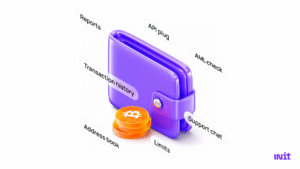
As crypto matures, products are evolving from simple wallets into operational financial tools. This changes what businesses expect from the interface.
Instead of focusing only on sending or receiving funds, companies increasingly need:
- structured transaction records,
- accounting-ready exports,
- reporting for internal reconciliation,
- compliance-related logs,
- clear payment statuses.
The difference between a basic wallet and a business-ready crypto platform often comes down to visibility and organization.
| Basic Wallet Experience | Business-Ready Experience |
|---|---|
| Raw transaction list | Structured reporting |
| Manual tracking | Searchable records |
| Hashes only | Human-readable context |
| Limited export options | Accounting-ready exports |
| Minimal history | Operational visibility |
These features may feel secondary, but they are what allow crypto to integrate into everyday business workflows.
Where INit Fits Into This Shift
This operational mindset is reflected in how INit approaches product design.
Rather than focusing only on transaction execution, INit also emphasizes the systems users need after a payment happens:
- accessible transaction history,
- structured financial records,
- transparent fee visibility,
- operational clarity inside Telegram,
- and compliance-oriented workflows.
The goal is not simply to move funds faster, but to make crypto easier to manage operationally over time. As businesses continue integrating crypto into real workflows, these “boring” features are becoming some of the most valuable parts of the product.
Final Thought
Crypto adoption is no longer driven only by trading or speculation. It is increasingly driven by operations. And operational systems depend on three simple things: clarity, structure, and reliable records.
Receipts and reporting may not create hype, but they create trust — and trust is what allows businesses to keep using crypto long-term.