Crypto has a fragmentation problem. One app to store assets. Another to exchange them. A separate service to check a wallet. A website to compare fees. A blockchain explorer to find an old transaction. A support chat when something goes wrong.
Each individual step may work. The friction appears in everything between them. INit takes a different approach. Instead of asking users to build their own crypto toolkit from scattered services, it brings everyday financial actions into one familiar environment: a Telegram chat.
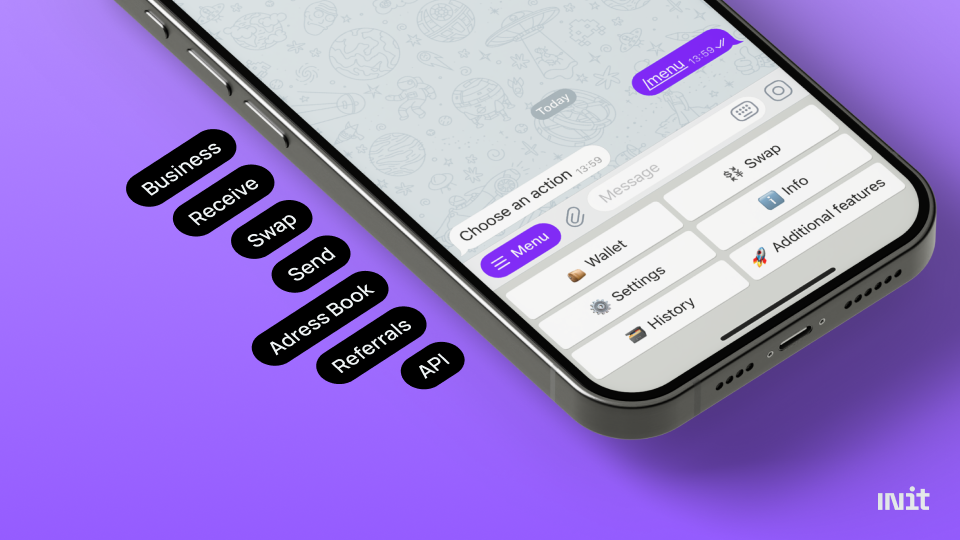
Send. Receive. Swap. Check a counterparty. Review a transaction. Save an address. Manage repeat payments. Connect a business system through an API.
The idea is simple: crypto should fit into the way people already work, rather than forcing people to reorganize their lives around crypto infrastructure. That is what makes INit interesting. It is built for two audiences that are often treated as separate: individuals who want crypto to feel easier, and businesses that need it to become more operational.
The same chat can support both.
The Interface Is the First Layer of the Product
Most crypto complexity does not come from a lack of functionality. It comes from the fact that users are constantly asked to think about the system.
Which platform should I open?
Where did I make that transaction?
Which address did I use last time?
What will the fee be?
Where do I check this counterparty?
Who do I contact if the status is unclear?
INit reduces that context switching by making Telegram the main point of interaction. This matters because Telegram is already a working environment for millions of people. Users communicate with clients, teams, communities, and partners there. Opening a crypto tool inside the same environment feels less like entering a separate financial system and more like continuing a conversation.
That does not mean reducing every crypto action to one mysterious button. Good simplicity is not about hiding everything. It is about showing the right thing at the right moment.
INit’s philosophy is closer to simple on the surface, structured underneath. A user can start with basic actions and discover more advanced tools only when they become relevant.
For Everyday Users: The Crypto Actions That Actually Repeat
Most people do not need a complex dashboard every day. They need a small number of actions to work reliably.
They receive funds.
They send them.
They exchange one asset for another.
They check what happened later.
INit brings these core flows into one place. Users can manage balances, deposit and withdraw funds, make swaps, view transaction history, and send assets directly through the bot. There are also features designed around how people actually use crypto repeatedly.
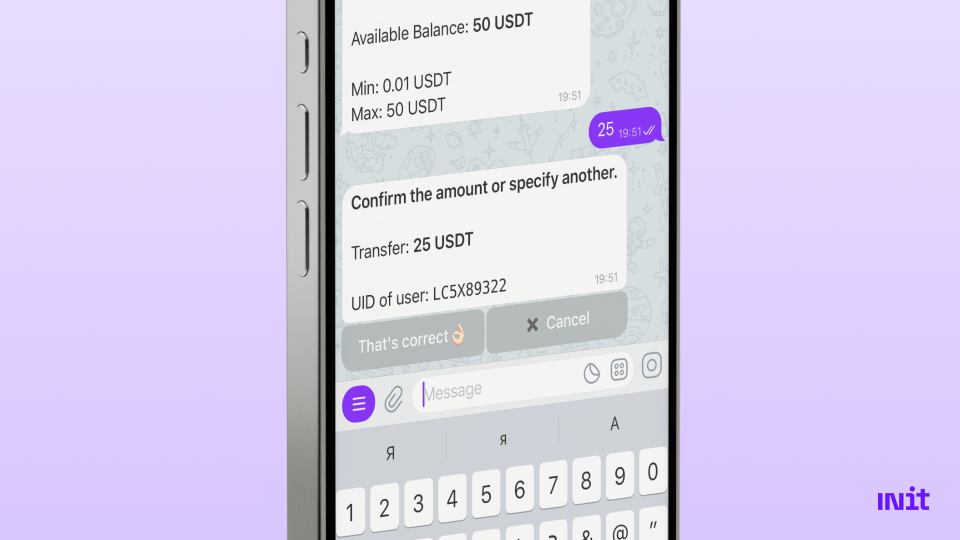
Internal transfers between INit users can be made through a UID, removing the need to enter a blockchain address for every payment. Limit orders give users another way to manage exchanges instead of requiring every conversion to happen immediately.
The value of these features is not that they make crypto look more advanced. They make repeated actions easier to repeat.
The Address Book Solves a Very Ordinary Crypto Problem
One of the most stressful parts of sending crypto is also one of the most basic: the address.
Long strings of characters are difficult to recognise and unpleasant to check. Yet users often send funds to the same people, businesses, or wallets more than once.
INit includes a built-in address book for crypto wallets and internal UIDs.
- A user can save a recipient once, give the entry a recognizable name, and use it again later. A whitelist can also be enabled so that transfers are limited to saved destinations.
This is not a headline-grabbing innovation. That is exactly why it matters. Many of the best financial features solve boring, repetitive problems. They reduce copying, searching, checking, and remembering.
The address book turns “Where did I save that wallet address?” into a solved problem. And that reflects a larger INit principle: everyday crypto becomes easier when the product remembers context, not only balances.
One Wallet Does Not Mean One Financial Stream
As crypto use grows, another problem appears. All incoming funds begin to look the same.
A freelancer may receive money from several clients. A business may run multiple projects. A user may want to separate different sources of income without creating a completely separate account for each one.
INit’s disposable address functionality allows additional addresses to be created and named for different purposes, clients, or payment streams.
Despite the name, these addresses are not necessarily limited to a single transaction. They can be used to create structure around incoming funds. That has a very practical benefit.
Instead of trying to remember which payment came from where, users can organise the flow before the money arrives.
- For an individual, that may mean separating personal and project income.
- For a business, it may mean creating clearer payment streams for different clients or services.
The blockchain records the transaction. The product should help the user understand its context.
Visibility Should Continue After “Send”
A financial tool should not become less useful once the transaction is complete.
INit keeps transaction history inside the bot, with statuses and detailed information for past operations. Users can return to deposits, swaps, and other activity rather than reconstructing everything from screenshots or external tools.
This becomes increasingly important as transaction volume grows.
- For occasional use, memory may be enough.
- For regular use, history becomes infrastructure.
Users need to know what happened, when it happened, how much was involved, what the status was, and what fees applied. The same logic applies to pricing.
INit publishes fee information and provides a calculator for previewing conversions before committing to them. The philosophy is straightforward: users should be able to see the financial conditions of an action rather than discover them afterwards.
Transparency is most valuable before a decision.
AML Checks Without Leaving the Flow
Crypto transactions often create one more question:
Who am I actually transacting with?
INit gives users access to AML checks directly through the bot. A wallet address or transaction can be analyzed, with the result provided as a risk assessment and detailed report. This makes the feature useful in real situations: before accepting a large payment, before sending funds to a new counterparty, or when a business wants more context around a transaction.
Users who need checks regularly can purchase them individually or in packages, while new verified users can begin with three free AML checks. The important part is where the tool lives.
Counterparty checking does not sit in an isolated compliance platform that users have to remember to open. It is available close to the transaction environment itself.
That makes AML less abstract. It becomes something a normal user or business can actually use when a decision needs to be made.

Small Controls Create a More Mature Experience
INit also includes tools that become more valuable as users do more.
Two-factor authentication adds another layer to account access and is required for sensitive functions such as creating API keys or using the address book. The whitelist gives users more control over where funds can be sent.
- Transaction records make previous activity easier to review.
- Multi-send allows separate transfers to multiple recipients to be created in one process.
None of these features exists to make the interface feel busier. They appear because crypto use changes with scale.
The person making their first swap does not need the same workflow as someone paying ten recipients. A freelancer does not have the same needs as a payment business. A company integrating crypto into its product needs a completely different level of access from someone sending funds to a friend.
A useful financial product should not force all of them into the same workflow. It should grow with the use case.
One Product, Different Levels of Need
| Need | Personal Use | Business Use |
|---|---|---|
| Send and receive funds | Direct transfers and UID payments | Repeatable payment flows |
| Manage recipients | Address book | Structured counterparties and recurring destinations |
| Organise incoming funds | Additional named addresses | Separate flows by client, project, or service |
| Review activity | Transaction history | Operational records and payment visibility |
| Check counterparties | On-demand AML checks | Repeat checks and AML packages |
| Send to multiple recipients | Occasional multi-send | Payout and batch-payment scenarios |
| Understand costs | Fee information and calculator | Cost visibility for recurring operations |
| Connect external systems | Usually unnecessary | API integrations and automation |
| Resolve questions | Direct support | Support for operational and technical issues |
The distinction matters because personal and business users do not need separate financial universes. They often need the same core infrastructure at different levels of depth.
For Businesses, the Chat Becomes an Entry Point — Not a Limit
A Telegram-native product could easily be mistaken for a consumer-only tool. That would miss the larger idea. For a business, Telegram can be the simplest entry point into a much broader financial workflow.
INit offers API access that allows external services and business systems to connect to account functionality. Businesses can create multiple API keys for different purposes, configure permissions, and restrict access by IP where needed.
This changes the role of the product. A business does not have to perform every action manually inside the chat. It can connect INit functionality with its own systems and build repeatable processes around it.
The chat remains useful for direct interaction. The API supports integration and automation. That combination matters because businesses rarely need another isolated dashboard. They need financial tools that can fit into the systems they already use.

Why Multi-Send Matters More to Businesses Than It Sounds
Sending one payment is a transaction. Sending payments to many recipients is an operation.
INit’s multi-send functionality allows users to create transfers to multiple recipients in one process, with individual amounts for each destination.
For an individual, this may be a convenience.
For a business, the logic is much larger.
Companies may need to pay contractors, partners, creators, service providers, or other distributed recipients. Repeating the same manual process for every payment creates unnecessary work and increases operational friction.
Multi-send is a good example of how a seemingly simple feature changes meaning depending on who uses it. The product does not need a completely different identity for business users. It needs to understand what happens when a simple action is repeated at scale.
A Business Crypto Tool Needs More Than Transactions
For businesses, sending and receiving crypto is only the visible part of the workflow. Around every transaction sit other questions:
Can we integrate this into our system?
Can we check the counterparty?
Can we separate different payment streams?
Can we find the record later?
Can we understand the cost before acting?
Can we reach someone when the standard flow does not answer the question?
This is where INit’s different functions start to work as one system rather than a collection of isolated features.
- The API supports integration.
- AML checks add counterparty context.
- Transaction history creates visibility.
- Disposable addresses help organise inflows.
- Multi-send supports repeated outbound flows.
- Transparent fee tools make costs easier to understand.
- Support covers the moments when an automated interface is not enough.
The business value comes from the combination.
The INit Philosophy: Less Infrastructure in the User’s Head
Crypto often asks users to understand too much. Networks. Addresses. Interfaces. Fees. Providers. Tools. Compliance services. Explorers.
Some of that complexity is unavoidable. But it does not all need to live in the user’s head.
That is the deeper idea behind INit. The product brings more of the workflow into one environment, keeps common actions close together, and gives users access to more advanced functionality when they need it.
A first-time user can begin with a simple transaction. A regular user can build an address book, organise funds, review history, and check counterparties.
A business can use multi-send, structure payment flows, purchase AML checks in packages, and connect its systems through an API.
The product becomes more useful as the use case becomes more serious. That is a better definition of simplicity than removing features. Real simplicity means the user does not have to assemble the system alone.
Why “One Chat” Matters
“One chat” may sound like a convenience feature. It is more than that.
Traditional financial products are built around destinations: open the app, visit the dashboard, enter the platform. Chat-based tools are built around continuity.
The financial action appears where the user is already present. This is particularly relevant for crypto, where many users already discover projects, communicate with teams, follow communities, and manage relationships through Telegram.
INit takes that existing behaviour and adds a financial layer to it. The result is not crypto hidden inside a messenger. It is a different way of thinking about the interface. The user should not need to visit complexity. The function should appear when it is needed.
Final Thought
The future of crypto will not be won by products that ask users to manage more infrastructure. It will be won by products that make infrastructure easier to use.
INit brings everyday crypto actions, practical controls, transaction tools, AML checks, business functionality, and API access into one connected environment.
For an individual, that means less switching and less friction. For a business, it means a more practical layer for real financial operations.
Different users.
Different flows.
One chat.
That is the point.