Crypto is often good at moving value. A stablecoin transfer can cross borders quickly. A blockchain transaction can settle outside banking hours. Funds can move between wallets without waiting for a traditional payment corridor to open.
But for many users and businesses, the real problem does not begin on-chain. It begins after the transfer. What happens when crypto needs to become usable money?
A company may receive stablecoins from an international client, but still need euros in a bank account to pay suppliers. A freelancer may get paid in USDT, but need local currency for rent. A business may hold crypto liquidity, but eventually need to move funds into fiat for accounting, taxes, payroll, or operational expenses.
This is the off-ramp problem. Moving crypto is one step. Turning it into money that can be used in the local financial system is another.
On-Chain Transfer Is Not the End of the Payment
In crypto, the visible success moment is often the transaction confirmation.
The funds arrived.
The hash exists.
The transfer is complete.
From a blockchain perspective, that may be true. From a business perspective, the financial process may still be unfinished. A payment is only truly useful when it reaches the form the recipient actually needs. That may be a stablecoin balance, but it may also be fiat currency, a bank transfer, a card payout, or a local payment method. This distinction matters because crypto adoption is not only about sending value faster. It is about making value usable after it arrives.
A fast on-chain transfer can still lead to a slow operational outcome if the off-ramp is expensive, unclear, delayed, or unavailable in the recipient’s market.
Why Off-Ramps Are Harder Than They Look
Off-ramping sounds simple: convert crypto to fiat and withdraw.
In practice, several layers sit between the asset and the final payout.
- There is liquidity. Can the provider support the amount and currency needed?
- There are fees and spreads. What does the user actually receive after conversion and withdrawal?
- There is timing. Is the payout instant, same-day, or delayed by banking hours and provider checks?
- There is compliance. Does the transaction require additional verification, source-of-funds information, or AML review?
- There are local payment methods. Can the funds be paid to the bank account, card, currency, or region the user actually needs?
This is why the off-ramp is often the least visible but most important part of a crypto payment flow. The blockchain leg may be global. The final mile is local.
The Difference Between Crypto Value and Usable Money
Crypto can move across networks. Businesses operate inside obligations.
Rent, payroll, invoices, taxes, and suppliers usually exist in local currencies and regulated financial systems. That means crypto must often pass through an off-ramp before it becomes operationally useful.
| Stage | What Happens | Main Friction |
|---|---|---|
| On-chain transfer | Crypto or stablecoin moves between wallets | Network choice, fees, confirmation time |
| Conversion | Crypto is exchanged into fiat or another asset | Liquidity, spread, exchange rate |
| Compliance review | Provider checks transaction and user context | AML/KYC, source of funds, limits |
| Payout | Funds move to bank, card, or local method | Banking hours, supported regions, payout rails |
| Business use | Money enters accounting or operations | Records, reconciliation, local currency alignment |
The hard part is not always the first step. It is connecting all steps into one predictable flow.
Why Businesses Feel the Off-Ramp Problem More Strongly
An individual user may off-ramp occasionally. A business may need to do it repeatedly, in different currencies, with different counterparties and documentation needs. That changes the standard.
Businesses need to know:
- what amount will arrive after fees,
- how long the payout may take,
- which currencies are supported,
- whether the transaction may require checks,
- where the record will be stored,
- and who can help if something is delayed.
Without that clarity, crypto can become difficult to plan around. A business cannot build reliable operations on “the money should arrive soon.”
It needs predictable routes, visible costs, clear records, and support when the standard flow is not enough. This is why off-ramp infrastructure matters for B2B crypto adoption. It turns crypto from a balance in a wallet into a usable financial flow.
Stablecoins Help, But They Do Not Remove the Last Mile
Stablecoins solve an important problem: volatility.
They make crypto payments more practical by giving users a digital asset linked to fiat value. That is why they are increasingly relevant for cross-border payments, platform payouts, treasury flows, and international business operations.
But a stablecoin is not the same as local money in a bank account.
A USDT payment may be fast, but if the recipient needs EUR, USD, UAH, PLN, or another local currency, the off-ramp still matters. The user still has to convert, withdraw, and receive funds through a supported route.
Stablecoins reduce one type of friction. They do not automatically solve liquidity, compliance, fees, timing, or local payout access.
That is why the future of crypto payments depends not only on better blockchain rails, but also on better bridges between crypto and real-world financial needs.
Where INit Fits Into This Shift
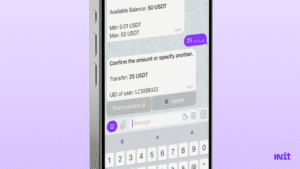
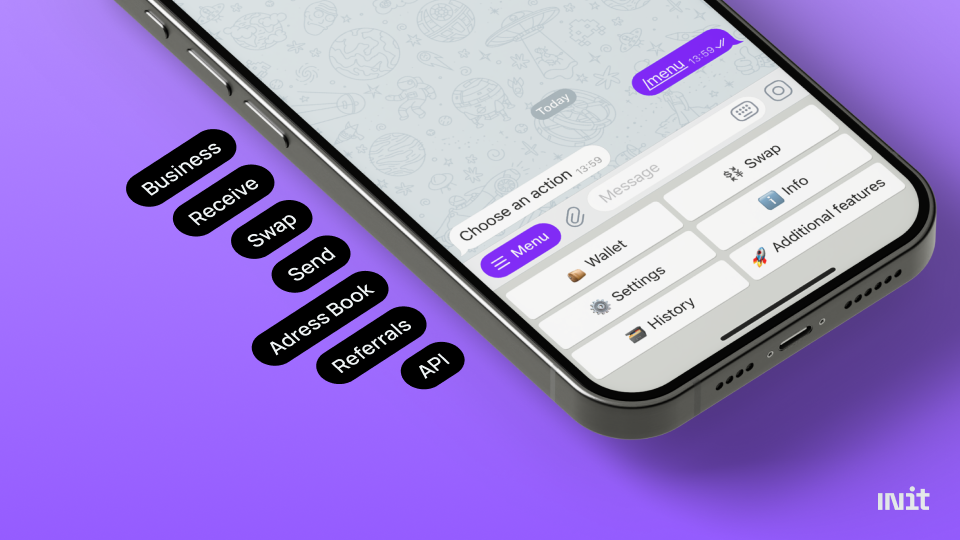
INit helps reduce the gap between crypto movement and practical money use by making key parts of the flow easier to manage in one Telegram-native environment.
- For users, this means access to exchanges, fee visibility, transaction history, AML checks, and support without jumping between disconnected tools.
- For businesses, the value is broader. Multi-currency options, transparent fees, support, and structured transaction flows make crypto easier to use as part of real operations rather than as a separate manual process.
The goal is to make the process clearer: what the user sends, what they receive, what fees apply, which route is being used, and where to get help when additional checks or questions appear. That clarity is what makes crypto more usable beyond the blockchain transaction itself.
The Last Mile of Crypto Adoption
Crypto adoption is often discussed in terms of speed.
Faster chains.
Faster settlements.
Faster transfers.
But the bigger adoption challenge may be usability after settlement.
Can the recipient actually use the funds?
Can a business record the transaction properly?
Can money move into the required currency?
Can the process work again next week, next month, and at higher volume?
This is the real off-ramp question.
Crypto does not become useful at the moment it moves. It becomes useful when it fits into the financial reality of the person or business receiving it.
Final Thought
Getting into crypto has become easier. Moving crypto has become faster. Getting out of crypto into usable money is still one of the hardest parts of the experience.
That does not make crypto less valuable. It shows where the next layer of adoption must happen.
The future of crypto payments will not be defined only by what happens on-chain. It will be defined by how smoothly crypto connects to local currencies, bank accounts, payouts, compliance processes, and everyday financial needs.
The off-ramp is not the end of the crypto journey. It is where crypto proves whether it can become useful in the real world.