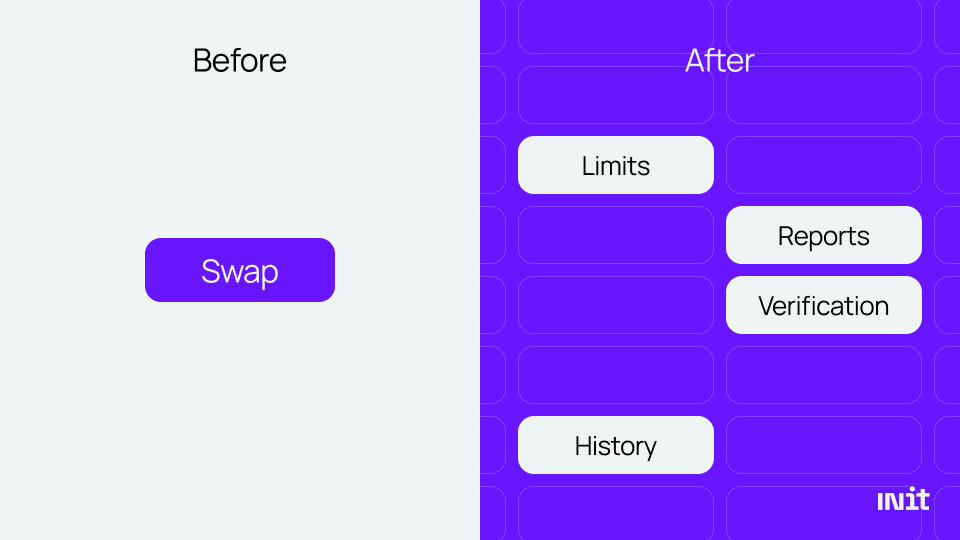
For years, crypto products competed on speed, features, and yield. Faster swaps.More tokens.Higher APY.Lower fees. But as crypto moves into everyday use — payments, business operations, recurring flows — a different metric is taking center stage: reliability. Not as a technical detail, but as a defining product quality. In 2026, users are no longer asking, […]
Keep ReadingDon’t Miss These
Crypto has always chased speed. From Bitcoin’s 10-minute blocks to sub-second finality, the industry has treated faster transactions as unquestionable progress. “Instant” became a promise, a headline, and eventually an expectation. But by 2025, a harder truth emerged:speed without guardrails doesn’t just reduce friction — it amplifies risk. As crypto moves from occasional transfers to […]
For a long time, crypto products were built around a single assumption: users come to crypto to hold assets or trade them. Wallets acted like vaults, exchanges like destinations, and most interactions were occasional rather than continuous. But as crypto matured, that assumption stopped matching reality. Today, users don’t want to “visit” crypto anymore. They […]
In crypto, trust rarely comes from a single promise.It emerges from a pattern. Users don’t wake up thinking, “Is this protocol audited?” They ask something more practical and human: “Does this feel safe?” And that feeling is shaped by signals — small, repeated cues that add up to confidence or doubt. This is the new […]
“Zero fees.”“Free swaps.”“No commission.” In crypto, free is one of the most powerful words in marketing. It promises frictionless access, fairness, and freedom from the hidden costs of traditional finance. But by 2026, most experienced users have learned an uncomfortable truth: Nothing in crypto is truly free. If a product doesn’t charge you directly, the […]
Crypto in 2025 didn’t feel like a single story. It felt like a system under stress-testing: big rallies, sharp liquidations, major hacks, shifting regulation, and a growing pipeline connecting crypto to traditional markets. If 2024 was about “institutional access,” 2025 was about what happens next—when access meets leverage, compliance, and real-world macro shocks. Below is […]
Crypto bots look simple on the surface.You open a chat, press a button, confirm a transaction — and everything just works. But that simplicity is an illusion. Behind every “instant” swap, every clean approval, every smooth user flow inside Telegram lives a complex system of micro-automations — small, specialized processes that operate silently in the […]
For years, the crypto industry searched for its perfect distribution channel.Web apps were powerful but complex. Mobile apps were regulated, slow to update, and expensive to acquire users through. Browser extensions introduced friction and security concerns. Then something unexpected happened. Telegram — originally just a messaging app — began quietly absorbing crypto activity. What started […]
For more than a decade, Telegram was seen simply as a messaging app — a place for conversations, communities, and broadcast channels.But as we enter the second wave of Web3 adoption, Telegram has quietly become something much bigger: a financial layer powered by bots, micro-transactions, and user-driven economic flows. Telegram today is no longer just […]
In the early days of Web3, growth was chaotic. Projects spent millions on advertising, influencer campaigns, and token incentives—yet users weren’t loyal, communities disappeared overnight, and most platforms struggled to create real trust. By 2025, one thing became clear:Web3 doesn’t grow through ads. It grows through people.And that’s exactly why referral models have become one […]