Crypto products were originally built for a narrow audience — people comfortable with volatility, technical complexity, and financial experimentation. Early adopters were developers, traders, and enthusiasts who understood the risks and were willing to navigate complicated interfaces in exchange for control.
But the industry has changed.
Today, crypto is used by a far broader range of participants:
- newcomers exploring digital assets for the first time
- businesses integrating crypto into operations
- experienced traders optimizing execution and liquidity
These groups do not behave the same way, and they do not face the same risks. As a result, modern crypto products must evolve beyond “one interface for everyone.”
The next generation of platforms must be designed around different risk profiles.
Understanding Risk Profiles in Crypto
A risk profile describes how a user approaches financial decisions, uncertainty, and complexity. In crypto, this affects how users interact with products, what safeguards they need, and how much control they expect.
While every individual is unique, most crypto users fall into three broad categories:
- Newcomers
- Professional or active traders
- Businesses and operational users
Designing for these profiles requires different priorities.
Newcomers: Reducing Cognitive Risk
New users often face the highest level of psychological risk. They are unfamiliar with wallets, irreversible transactions, network fees, and the mechanics of blockchain systems.
For this group, mistakes are common and confidence is fragile.
Products designed for newcomers should focus on:
- simplified flows
- clear explanations
- visible transaction previews
- warnings before irreversible actions
- default safeguards
The goal is not to remove control, but to reduce cognitive load.
For example, instead of presenting multiple routing options or advanced parameters immediately, platforms can offer a guided flow that explains what is happening at each step.
When users feel informed rather than overwhelmed, they are more likely to complete transactions and continue using the product.
Traders: Maximizing Control and Precision
Experienced users approach crypto very differently.
They understand market dynamics, network costs, and execution risk. Instead of reducing options, they expect greater visibility and control.
For traders, the priorities include:
- execution speed
- liquidity depth
- routing transparency
- customizable parameters
- detailed transaction data
Hiding information from this group can actually create frustration. Where newcomers benefit from simplified interfaces, traders benefit from precision tools.
The best platforms therefore allow advanced users to access deeper layers of information without forcing those layers onto beginners.
Businesses: Managing Operational Risk
A third and increasingly important category consists of businesses using crypto in operational workflows.
Examples include:
- cross-border payments
- treasury management
- merchant settlements
- API integrations
- liquidity operations
For businesses, the primary risk is not volatility — it is operational uncertainty.
They need:
- predictable fees
- transaction traceability
- compliance processes
- reliable infrastructure
- audit-ready reporting
Designing for this group requires a different mindset. The interface must support repeatable workflows, not just one-off transactions. Consistency and transparency become more important than visual simplicity.
Why a Single UX No Longer Works
Historically, many crypto products attempted to serve all users through the same interface. This approach often led to two problems:
- Overwhelming beginners with advanced options
- Frustrating professionals by hiding useful data
A single universal interface inevitably favors one group at the expense of others.
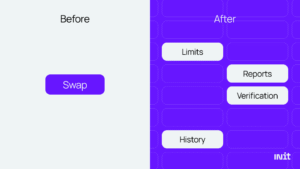
Modern product design is therefore moving toward layered UX models, where complexity is introduced progressively rather than all at once. This approach allows users to grow with the product.
Layered Interfaces: A Practical Approach
A layered UX typically separates functionality into different levels:
| User Type | UX Approach | Design Focus |
|---|---|---|
| New Users | Guided flows and simplified actions | Clarity and safety |
| Traders | Advanced controls and detailed data | Precision and performance |
| Businesses | Structured workflows and reporting | Predictability and reliability |
Instead of forcing every user through the same interface, the product adapts to the user’s level of experience and risk tolerance. This structure allows platforms to remain accessible without sacrificing functionality.
Risk Communication as UX
Another key design principle involves communicating risk clearly within the interface.
Crypto products can reduce mistakes by making risk visible at the right moments.
Examples include:
- transaction previews before confirmation
- clear fee breakdowns
- warnings for unusual behavior
- explanations of network costs
- confirmation delays for high-value transfers
These elements do not slow down experienced users, but they significantly reduce the likelihood of costly mistakes for less experienced participants. In financial products, clarity often matters more than speed.
The Role of Infrastructure in Risk Design
Adapting to different risk profiles is not only a design challenge. It also requires strong backend infrastructure.
Systems must support:
- compliance verification
- transaction monitoring
- routing optimization
- user-level permissions
- operational reporting
Without these systems, risk-aware interfaces cannot function reliably.
This is why UX design and infrastructure architecture are increasingly interconnected in modern crypto platforms.
How INit Approaches Risk-Aware Design
This philosophy also shapes the design approach of INit.
INit operates within a messaging-based environment, which places a strong emphasis on clarity and simplicity. At the same time, the product must remain capable of supporting more advanced users and operational workflows.
To balance these needs, INit focuses on several principles:
Clear and structured flows
Transactions are presented in a way that makes each step understandable, reducing the chance of accidental actions.
Transparent pricing and execution
Users can see fee information and estimate transaction costs in advance through the fee information available on the website and within the bot, as well as through the fee calculator.
Compliance and verification infrastructure
Verification processes are integrated into the user journey so that regulatory requirements do not disrupt the overall experience.
Accessible support
When questions arise, users have access to human support to clarify processes and reduce uncertainty.
This structure allows the product to remain approachable for newcomers while still providing the reliability and transparency needed by more experienced users and business clients.

The Future of Risk-Aware Crypto Products
As crypto adoption expands, the diversity of users will continue to increase. Platforms will no longer succeed by optimizing for a single audience.
Instead, successful products will:
- adapt to different levels of experience
- communicate risk clearly
- balance simplicity with control
- support both individuals and institutions
Designing crypto for different risk profiles is not about limiting users. It is about building systems that allow more people to participate safely and confidently.
And in a financial ecosystem built on irreversible transactions, that kind of design may be one of the most important innovations still ahead.