For years, the crypto industry searched for its perfect distribution channel.
Web apps were powerful but complex. Mobile apps were regulated, slow to update, and expensive to acquire users through. Browser extensions introduced friction and security concerns.
Then something unexpected happened.
Telegram — originally just a messaging app — began quietly absorbing crypto activity. What started with basic bots evolved into wallets, DEX interfaces, payment tools, analytics dashboards, compliance utilities, and business infrastructure. By late 2025, Telegram is no longer just hosting crypto tools.
It is beginning to resemble something much bigger.
Telegram is becoming the App Store of crypto — but with very different rules.
1. Why Crypto Needed a New “App Store” in the First Place
Traditional app distribution models were never designed for Web3.
Crypto products face unique challenges:
- global users with different regulations,
- constant updates and protocol changes,
- security-sensitive operations,
- onboarding users with no technical background,
- restrictions from Apple and Google,
- advertising bans or limitations,
- high user acquisition costs.
The result: powerful tools, but limited reach.
Crypto needed a place where tools could be:
- deployed instantly,
- updated without approval delays,
- shared peer-to-peer,
- discovered socially,
- used without downloads,
- and accessed globally.
Telegram accidentally solved all of this.
Key takeaway
Crypto didn’t move to Telegram because it was trendy — it moved there because existing app stores were structurally incompatible with Web3.
2. What Makes Telegram App-Store-Like (But Not a Copy)
Telegram does not look like an app store — there are no grids of icons or rankings in the classic sense.
Yet functionally, it performs many of the same roles, often more efficiently.
Let’s compare.
Telegram vs Traditional App Stores
| Feature | Traditional App Stores | Telegram |
|---|---|---|
| App approval | Centralized review | Instant bot deployment |
| Updates | Manual review & delays | Live updates in real time |
| Distribution | Algorithmic rankings | Social sharing & links |
| User acquisition | Paid ads, ASO | Communities & referrals |
| Global reach | Region-locked | Borderless by default |
| Monetization | Platform fees | Direct payments, crypto-native |
| UX | App installs | Chat-native, no install |
| Compliance model | Platform-enforced | Tool-level responsibility |
Telegram doesn’t replace the App Store model —
it rewrites it around social distribution and instant access.
Key takeaway
Telegram acts as an App Store without acting like a gatekeeper. Distribution is social, not algorithmic.
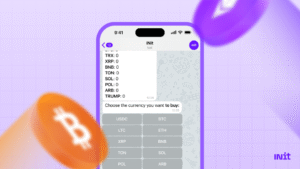
3. Bots Are Crypto’s New “Apps
In Telegram, bots function exactly like apps:
- they have interfaces,
- they perform specific tasks,
- they integrate APIs,
- they manage permissions,
- they process payments,
- they evolve over time.
But bots are lighter, faster, and easier to adopt.
A user doesn’t “install” a crypto bot — they open a link.
They don’t update it — it updates itself.
They don’t search an app store — they receive it from a friend or channel.
This radically lowers the barrier to entry.
That’s why in 2024–2025 we saw:
- trading bots explode in usage,
- wallet bots onboard millions,
- swap bots replace simple DEX frontends,
- payment bots become merchant tools,
- analytics bots turn into portfolio dashboards,
- compliance bots offer AML checks on demand.
Tools that would struggle to gain traction as apps often thrive as Telegram bots.
Key takeaway
Bots are not “lite apps” — they are a more efficient form of crypto application for most users.
4. Channels Replace App Rankings
In traditional app stores, discovery is driven by:
- rankings,
- categories,
- paid placements,
- editorial features.
In Telegram, discovery works differently.
Channels and communities are the discovery layer.
When a trusted channel shares a bot:
- thousands of users try it instantly,
- feedback loops are immediate,
- adoption happens in hours, not weeks,
- virality is built-in.
Channels act as:
- app curators,
- recommendation engines,
- trust filters,
- distribution hubs.
This is especially powerful in crypto, where users rely heavily on community validation.
Key takeaway
Telegram replaced algorithmic discovery with social discovery — and crypto users trust it more.
5. Micro-Transactions Change Monetization
Traditional app stores monetize through:
- subscriptions,
- in-app purchases,
- platform fees,
- ads.
Telegram-based crypto tools monetize differently:
- micro-fees per action,
- pay-per-use utilities,
- on-chain transactions,
- subscriptions paid in stablecoins,
- tipping and donations,
- referral-driven rewards.
Because crypto payments are native, monetization feels less intrusive and more flexible.
This enables:
- small payments that would be impossible with fiat rails,
- global monetization from day one,
- creator-led business models,
- service-based pricing instead of lock-in subscriptions.
Tools like INit benefit from this structure by offering:
- transparent fee models,
- optional paid features (e.g. AML Packs),
- business-grade services through APIs,
- rewards for participation and referrals.
Key takeaway
Telegram enables crypto-native monetization that app stores simply can’t support.
6. Compliance Becomes the New App-Store Filter
One major difference between Telegram and classic app stores is responsibility.
In app stores:
- Apple or Google enforce rules.
In Telegram: - responsibility moves to the tool itself.
As regulation (MiCA, AML standards) expands, a new filter emerges:
compliance-readiness.
By late 2025:
- bots without AML/KYT struggle to scale,
- businesses demand compliance tools,
- users prefer platforms that feel safe,
- Telegram itself increasingly favors verified, compliant bots.
Compliance becomes the new “quality badge.”
Platforms like INit, which integrate:
- automated AML checks,
- risk scoring,
- transparent fees,
- business reporting,
- optional verification,
are better positioned for long-term visibility and partnerships.
Key takeaway
In Telegram’s “App Store”, compliance replaces centralized moderation.
7. Why Telegram Works Especially Well for Crypto (and Not Everything Else)
Telegram won’t replace app stores for:
- games with heavy graphics,
- complex productivity tools,
- OS-level integrations.
But for crypto, it’s almost ideal.
Crypto needs:
- instant global access,
- constant iteration,
- low friction onboarding,
- social trust,
- programmable automation,
- financial UX.
Telegram delivers all of these natively.
That’s why crypto tools are not just present in Telegram —
they are thriving there.
Key takeaway
Telegram is not a universal App Store — but it may be the perfect one for crypto.
8. Where This Is Going Next (2026 and Beyond)
Based on current momentum, the next phase looks like this:
- Bot Store evolution with clearer categories and verification
- Compliance labels and trust signals
- Cross-bot integrations (bots working together)
- Identity layers reused across tools
- Business-grade crypto services fully inside Telegram
- Referral-driven growth replacing paid ads
- AI-enhanced bots acting as financial assistants
Telegram is moving from “tool hosting” to ecosystem orchestration.
9. Final Thoughts: Telegram as Crypto’s Distribution Layer
Telegram doesn’t look like an App Store.
It doesn’t behave like an App Store.
And yet, functionally, it is becoming the most effective distribution layer crypto has ever had.
It combines:
- instant access,
- social trust,
- native payments,
- automation,
- global reach,
- and rapid innovation.
For users, it feels natural.
For builders, it’s powerful.
For crypto, it might be transformational.
Platforms like INit are being built specifically for this reality — not as apps competing for attention, but as Telegram-native tools designed to be shared, trusted, and used where crypto already lives.
Telegram may not call itself an App Store —
but for crypto tools, it’s rapidly becoming one.