For years, compliance lived far away from product design.
It was something legal teams handled, something hidden in PDFs, something users encountered only when something went wrong. UX teams focused on speed and simplicity. Compliance focused on rules and risk. The two barely spoke.
That separation no longer works.
As crypto products move into everyday use — and as regulation becomes unavoidable — compliance is no longer just a legal requirement. It’s a user experience problem. And for the teams that understand this early, it’s also a major opportunity.
1. How Regulation Quietly Moved Into the Interface
In early crypto products, users could move value with almost no friction. Few questions were asked. Few explanations were given. That freedom was part of the appeal—but it also created risk.
Today, regulatory frameworks (like AML, KYT, travel rules, reporting requirements) require products to:
- verify users,
- assess transaction risk,
- monitor flows,
- block or delay suspicious activity,
- and keep audit-ready records.
All of this now happens inside the product, not outside of it.
Which means users don’t just “comply” anymore — they experience compliance.
2. Why Compliance Feels Like Bad UX (At First)
Most users don’t dislike compliance because it’s unfair.
They dislike it because it’s often poorly designed.
Common problems include:
- sudden blockers with no explanation,
- confusing requests at the wrong moment,
- unclear next steps,
- long waiting times without feedback,
- legal language instead of human language.
From the user’s perspective, it feels arbitrary and hostile — even when it’s required.
This is where many products fail: they treat compliance as an interruption instead of a designed flow.
3. Compliance Is a UX Problem Because It Breaks Flow
Good UX protects flow.
Bad compliance breaks it.
When users are in the middle of an action —s ending funds, making a payment, running a business flow — any friction feels amplified. If the product suddenly stops them without context, trust erodes instantly.
The real UX challenge isn’t whether to comply.
It’s how compliance enters the user journey.
Timing, explanation, predictability, and tone matter just as much as the rule itself.
4. The Opportunity: Turning Rules Into Structure
Here’s the shift forward-thinking teams are making:
Instead of asking, “How do we add compliance?”
They ask, “How do we design around it?”
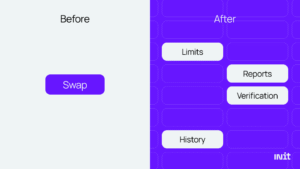
When compliance is integrated early into UX design, it can actually:
- reduce user anxiety,
- prevent irreversible mistakes,
- increase trust,
- and make products feel more professional and reliable.
In other words, compliance can become a stabilizing force, not a blocker.
5. What Good Compliance UX Looks Like
Well-designed compliance doesn’t feel like a wall.
It feels like guidance.
Key characteristics include:
- Expectation setting
Users know in advance what checks exist and why. - Human explanations
Clear, plain-language messages instead of legal terms. - Predictable behavior
Similar actions trigger similar outcomes—no surprises. - Visible progress
If something takes time, users see what’s happening. - Graceful limits
Restrictions feel protective, not punitive.
When done well, users don’t fight compliance—they accept it.
6. Compliance as a Trust Signal
Ironically, users often trust products more when compliance is handled transparently.
Why?
Because structure signals seriousness.
A product that:
- explains why something is blocked,
- shows how fees and checks work,
- provides support when questions arise,
feels safer than one that allows everything instantly without safeguards. In a maturing market, trust often outweighs raw speed.
7. How INit Approaches Compliance as UX
This is the mindset behind INit.
Instead of treating compliance as an external burden, INit designs it as a natural part of the user experience:
- compliance logic runs quietly in the background,
- users are informed before actions, not surprised after,
- communication is clear, human, and contextual,
- and live support is available whenever something needs clarification.
Verification is handled through Sumsub, a trusted compliance platform that allows users to complete KYC using different types of documents — including an ID card, residence permit, passport, or driver’s license.
The entire verification flow takes 6 simple steps and usually 5–10 minutes to complete, making compliance feel structured and predictable rather than disruptive.
The goal isn’t to slow users down — it’s to help them move forward with confidence and clarity, even in regulated environments.
That’s how regulation turns from friction into structure.
8. Why This Will Matter Even More Going Forward
As crypto tools are used for:
- everyday payments,
- business operations,
- recurring workflows,
users will no longer tolerate opaque systems.
They’ll expect:
- clear rules,
- predictable behavior,
- and interfaces that explain why—not just what.
Products that ignore UX in compliance will feel hostile.
Products that design for it will feel trustworthy.
Final Thought
Compliance isn’t going away.
But bad compliance UX should.
The next generation of crypto products won’t win by avoiding rules. They’ll win by designing better experiences around them.
In that future, compliance isn’t just a legal necessity.
It’s a competitive advantage.