The payment industry often frames innovation as a race.
Cards versus cash.
Fintechs versus banks.
Crypto versus traditional finance.
Stablecoins versus instant payments.
But this framing is often too simple.
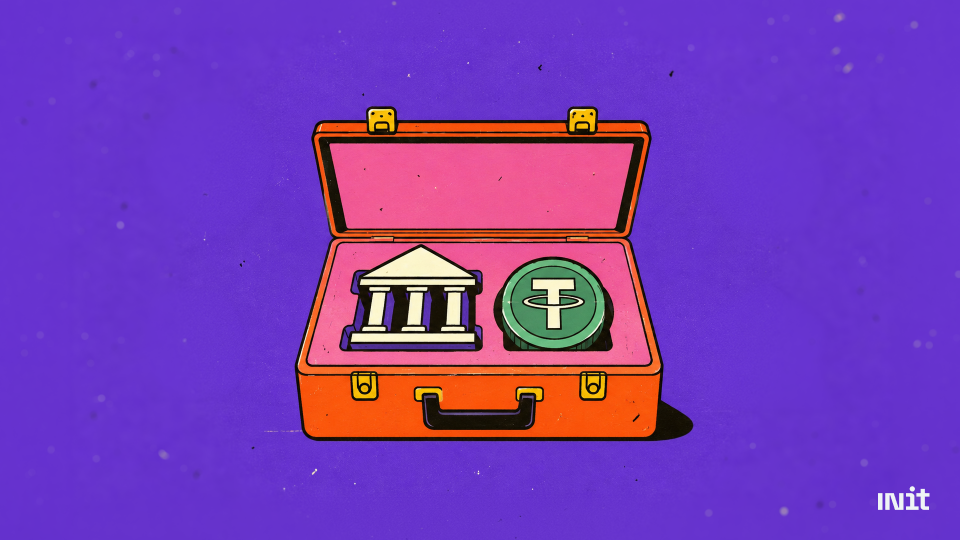
Instant bank payments and stablecoin payments are growing at the same time because they solve different problems. One is strongest inside existing financial systems. The other becomes more useful when money needs to move across borders, currencies, platforms, and digital-native workflows.
The real question is not which rail will “win.”
The better question is:
Which payment rail fits the job?
Instant Bank Payments Solve Local Friction
Instant payment systems were built to improve domestic and regional money movement.
Systems like Pix in Brazil, FedNow in the United States, and SEPA Instant in Europe are designed to make bank-based payments faster and more available. Instead of waiting hours or days for funds to move between accounts, users and businesses can send money in real time or near real time.
This is a major improvement.
For local payments, instant bank rails can be extremely effective. They connect to regulated financial institutions, support familiar account structures, and often fit naturally into existing banking and accounting processes.
A business paying a local supplier, receiving funds from a domestic customer, or moving money inside one currency area may not need crypto at all. If the bank rail is fast, affordable, available, and easy to reconcile, it may be the best tool for the job. That matters because crypto does not need to replace every payment system to be useful.
Stablecoins Solve a Different Kind of Friction
Stablecoins are strongest where traditional payment infrastructure becomes fragmented. Cross-border payments often involve multiple banks, intermediaries, currencies, settlement windows, and compliance checks. Even when the sending experience looks simple, the process behind it may still be slow or expensive.
Stablecoins create a different model: value moves on blockchain rails, often outside traditional banking hours and across global networks.
This makes them especially relevant for:
- international contractors,
- cross-border business payments,
- platform payouts,
- crypto-native companies,
- digital services,
- multi-currency treasury flows.
Stablecoins are not automatically better for every payment. They introduce their own requirements: custody, wallet management, network choice, counterparty checks, fees, and off-ramp access. But in the right context, they can reduce friction that local instant payment systems were not designed to solve.
Local Rails Are Deep. Stablecoin Rails Are Wide
The easiest way to understand the difference is to look at the shape of each system. Instant bank payments are often deep within a local or regional market. They work well because they are connected to domestic banks, local account systems, consumer habits, and regulatory frameworks.
Stablecoin payments are wide. They are not tied to one country’s banking system in the same way, which makes them useful for international and digital-first use cases.
| Payment Need | Instant Bank Payments | Stablecoins |
|---|---|---|
| Domestic payments | Usually strong | Often unnecessary |
| Local currency settlement | Strong | Depends on stablecoin and off-ramp |
| Cross-border transfers | Limited by corridor and banking partners | Stronger fit for global movement |
| 24/7 digital settlement | Increasingly available | Native to blockchain networks |
| Multi-currency operations | Often fragmented | More flexible, but requires infrastructure |
| Integration with existing bank accounts | Strong | Requires wallet, custody, or provider layer |
| Crypto-native workflows | Weak fit | Strong fit |
| Consumer familiarity | High in supported markets | Still developing |
This is not a scoreboard. It is a reminder that payment rails should be judged by use case, not ideology.
Why Businesses Need Both
Most modern businesses do not live inside one payment environment. A company may receive local bank transfers from domestic clients, pay international contractors in stablecoins, use cards for subscriptions, hold part of its liquidity in fiat, and operate with crypto partners.
This is why the future of payments is unlikely to be one rail replacing all others. It will be a multi-rail environment.
Businesses will choose payment methods based on practical factors:
- location,
- currency,
- speed,
- fees,
- documentation,
- counterparty preference,
- compliance requirements,
- and integration needs.
In this environment, the most valuable financial tools will not be the ones that force companies into one system. They will be the ones that help businesses choose the right route for each transaction.
A domestic invoice may belong on an instant bank rail.
A cross-border stablecoin payout may belong on crypto rails.
A recurring business payment may need whichever option integrates better into the workflow.
The value is in flexibility.
The Mistake of Treating Stablecoins as “Better Bank Transfers”
Stablecoins are often explained as faster bank transfers. That comparison is useful, but incomplete.
A bank transfer moves money between accounts inside a regulated banking system. A stablecoin payment moves a digital asset between wallets or accounts on blockchain-based infrastructure. That difference changes the operational model.
With stablecoins, businesses need to think about:
- which asset is being used,
- which network it moves on,
- who controls the wallet,
- how fees are calculated,
- whether the counterparty has been checked,
- how records are stored,
- and how funds can be converted or used after receipt.
These are not reasons to avoid stablecoins. They are reasons to use them deliberately.
Stablecoins become most useful when they are not treated as a universal replacement for bank transfers, but as an additional rail with its own strengths.
Where INit Fits Into the Multi-Rail Future
INit fits into this shift by supporting a more flexible view of crypto payments. The point is not “crypto instead of everything.” The point is having another practical route when crypto makes sense.
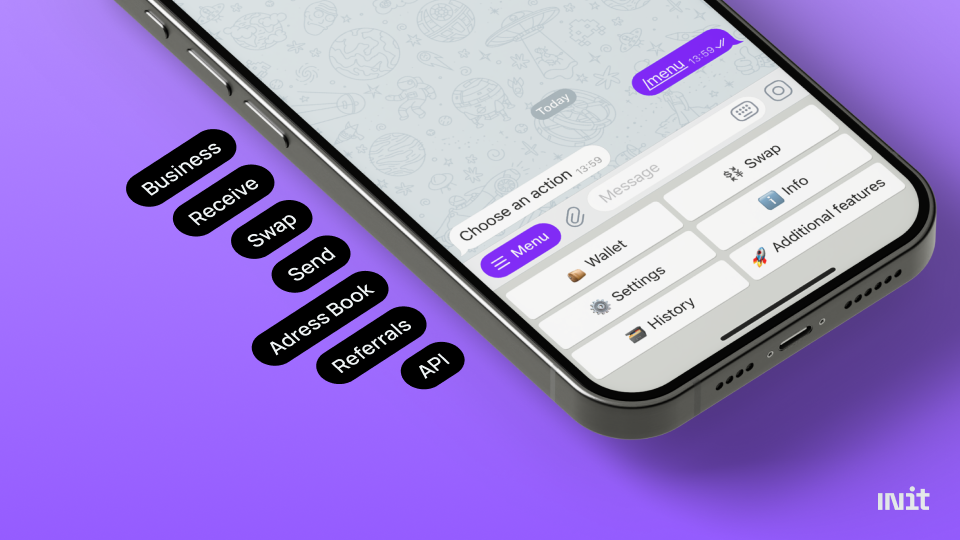
For individual users, this can mean easier access to transfers, swaps, fee information, transaction history, AML checks, and saved recipients inside Telegram.
For businesses, INit can support more structured financial operations through tools such as multi-send, address book, AML packs, transparent fee visibility, support, and API access.
These features matter because stablecoin and crypto payments are not only about sending value. They also require context around the transaction: who the recipient is, what fee applies, what status the payment has, whether the counterparty should be checked, and how the process connects to the wider workflow.
INit helps make crypto rails more usable as part of a broader payment setup. Not as the only rail. As the right rail for the right scenario.
Final Thought
Instant bank payments and stablecoins are not solving the same problem. Instant bank payments make local and regional account-to-account transfers faster. Stablecoins make global, digital, and cross-border value movement more flexible.
Both can be useful. Both have limits. The future of payments is not a single winner. It is a smarter mix of rails, chosen by context. For businesses, the goal is not to pick a side. It is to understand which payment method fits the job.