Stablecoins were built to make money more portable. They can move across borders, operate outside banking hours, and settle on digital networks that are accessible globally. In theory, this should make the currency behind them less important.
In practice, the opposite is happening.The more stablecoins move from crypto trading into real payments, business operations, and treasury workflows, the more one question returns:
Which currency should the money actually be in?
For most of the crypto economy, the answer has been the US dollar. Dollar-denominated stablecoins became the default settlement asset long before stablecoins were widely discussed as payment infrastructure. Liquidity, exchange pairs, trading activity, and global crypto markets were built around them.
But a business in Paris does not necessarily think in dollars. Neither does a finance team in Berlin, a SaaS company billing European customers, nor a contractor whose expenses and taxes are denominated in euros. That gap between a global payment rail and a local financial reality is creating a new conversation around EUR stablecoins.
And while euro-denominated stablecoins remain a very small part of the market, their recent growth suggests the question is becoming harder to ignore.
Stablecoins Became Global. Business Accounting Did Not.
The dominance of dollar stablecoins makes sense. The dollar already plays a central role in international finance, trade, reserves, and cross-border settlement. Crypto did not invent that preference. It extended it onto blockchain rails. For traders and many global businesses, a dollar-denominated asset is convenient because it creates a common reference point. One stablecoin can be used across markets, exchanges, networks, and counterparties without requiring a different local currency for every country.
But businesses do not operate entirely in a global abstraction.
They pay salaries, taxes, suppliers, rent, and invoices in specific currencies. They prepare budgets in those currencies. Their revenues and liabilities are often measured in them. A European company may receive a payment in a dollar stablecoin and technically receive value almost instantly. But if its invoices, expenses, and accounting are in euros, the payment has not completed the entire financial job.
The company still has a currency decision to make.
Should it keep the funds in dollars?
Convert immediately?
Wait for a better rate?
Accept the FX exposure?
Pay conversion costs later?
This is where the local currency question begins. A payment can be fast at the transaction layer and still create work at the accounting layer.
The Hidden FX Layer Behind “Global” Payments
Imagine a European business invoices a client for €50,000 but receives the equivalent value in a dollar-denominated stablecoin. The transfer itself may be efficient. But the business now holds an asset whose value changes against the currency in which the invoice was issued.
If the company needs euros for payroll or suppliers, the final result depends on:
- the EUR/USD exchange rate,
- when the conversion happens,
- the available liquidity,
- and the cost of moving between currencies.
For a one-time payment, this may be manageable. Across hundreds or thousands of transactions, it becomes an operational layer. The issue is not that dollar stablecoins are unsuitable. For many use cases, they remain the most practical option because of their deeper liquidity and wider availability.
The issue is that global liquidity and local financial alignment are not the same thing. The best currency for moving money may not always be the best currency for running the business.
That distinction matters more as stablecoins become part of everyday operations rather than occasional crypto transactions.
EUR Stablecoins Are Growing — From a Very Small Base
The current market still leaves little doubt about which currency dominates. According to TRM Labs, EUR-denominated stablecoin activity grew twelvefold between January 2025 and March 2026, rising from around $69 million to $777 million in monthly volume.
That is significant growth. But scale matters. Even after that increase, EUR-denominated stablecoins still represented less than 0.3% of total VASP volume measured by TRM Labs.
A similar gap appears in market capitalization. ECB analysis showed that euro-denominated stablecoins had a market capitalization of roughly €450 million in January 2026, compared with around $300 billion for dollar-denominated stablecoins. So the story is not that the euro is catching the dollar.
It is that a previously marginal category is beginning to develop its own use cases. This distinction is important. Rapid percentage growth can look dramatic when the starting point is small. The more interesting question is not whether EUR stablecoins can replicate the entire dollar stablecoin market.
It is whether some European users and businesses now have better reasons to choose a euro-denominated digital asset than they did before.
Where Local Currency Creates Real Business Value
The strongest case for EUR stablecoins is not ideological. It is operational. Consider a business that earns revenue in euros, reports in euros, and pays most of its expenses in euros. For that company, receiving a euro-denominated stablecoin can remove an unnecessary currency layer from a crypto payment.
| Business Situation | USD Stablecoin Logic | EUR Stablecoin Logic |
|---|---|---|
| European company billing in EUR | Adds currency exposure before conversion | Keeps payment aligned with invoice currency |
| Paying euro-area suppliers | May require an additional FX step | Can match the supplier’s operating currency |
| Holding short-term operating liquidity | Useful for global dollar exposure | Better aligned with EUR-denominated expenses |
| Serving international crypto markets | Usually stronger liquidity and acceptance | More limited reach today |
| Accounting and reconciliation | May require exchange-rate treatment | Can simplify matching with EUR records |
| Global trading and crypto liquidity | Often the default choice | Usually a secondary option |
The table does not produce one universal winner. That is the point. Currency choice becomes useful when it follows the business context rather than market habit.
A company with global dollar revenue may prefer dollar stablecoins. A European company collecting euro-denominated subscriptions may see more value in a euro asset. A business operating across both may need access to both. The future is likely to be multi-currency because businesses already are.
MiCA Changed More Than the Compliance Conversation
Regulation is another reason Europe is becoming a distinct stablecoin market.
Under the EU’s Markets in Crypto-Assets Regulation, stablecoins fall within a more defined regulatory structure. Tokens referencing a single official currency are generally treated as e-money tokens, with requirements around issuers, transparency, supervision, and reserves.
This does not automatically make euro stablecoins successful. Regulation cannot create liquidity, user demand, or distribution by itself. But it changes the environment in which businesses evaluate the product.
For companies, the questions around a stablecoin are increasingly broader than:
“Does it hold its peg?”
They also include:
Who issues it?
Under which framework?
How does redemption work?
Can our service provider legally support it?
How does it fit into our compliance process?
MiCA gives Europe a more structured answer to some of those questions. At the same time, the relationship between crypto regulation and existing payment rules remains complex, particularly when e-money tokens are used for payment services.
That complexity is not a reason to dismiss the market. It is evident that stablecoins are moving closer to real financial infrastructure, where regulatory classification matters because the product is doing more than sitting in a wallet.
The User Trust Question Is Also a Currency Question
There is another, less technical side to local currency: how people understand value. A European customer may be perfectly comfortable using crypto while still thinking in euros.
They know what €20 means. They know whether €500 is expensive. They understand their salary, subscriptions, rent, and budget in the same unit. A payment denominated in another currency introduces a small mental calculation. For experienced users, this is easy. For mainstream users, repeated conversion creates friction.
This is why local pricing has always mattered in digital commerce.
Companies do not show every European customer a dollar price simply because the internet is global. They localise prices because currency is part of how people understand a product.
Stablecoins will face the same reality as they move beyond crypto-native audiences. A global rail does not eliminate local financial habits. In some cases, trust comes from recognizing the currency before understanding the technology behind it.
Why This Matters More for Payments Than Trading
The local currency question becomes especially important when stablecoins are used repeatedly. A trader may move between assets and currencies as part of normal activity. A business payment is different.
Recurring payments, supplier settlements, subscriptions, contractor payouts, and treasury operations become easier to manage when the currency of the payment matches the currency of the obligation.
This is where euro stablecoins may find a more durable role.
Not as a universal replacement for dollar stablecoins.
Not as a speculative alternative.
But as infrastructure for specific euro-denominated flows.
That could include:
- business-to-business payments,
- European platform payouts,
- digital services priced in euros,
- contractor payments,
- short-term operational liquidity,
- and settlements between counterparties whose financial records are already euro-based.
The strongest use case is often the least dramatic one: removing one unnecessary conversion from a repeatable workflow.
The Future Is Not USD Versus EUR
It is tempting to frame the stablecoin market as a currency competition. But businesses rarely choose financial infrastructure that way.
They choose based on:
- where they earn,
- where they spend,
- what their counterparties accept,
- what liquidity is available,
- how much conversion costs,
- and how the transaction fits into their internal systems.
Dollar stablecoins will likely remain essential because they already have the strongest network effects and global crypto liquidity. Euro stablecoins can still become important without challenging that dominance directly.
They only need to solve a different problem. For a European business, the valuable question may not be:
“Which stablecoin is bigger?”
It may be:
“Which currency creates the least friction between receiving money and actually using it?”
That is a much more practical standard.
Where INit Fits Into a Multi-Currency Future
For INit, the rise of local-currency stablecoins points toward a broader change in payment infrastructure. Businesses increasingly need more than speed. They need payment options that fit the way they actually operate.
That means access to different currencies, clearer transaction flows, transparent fees, and the flexibility to choose the most practical route for each situation.
A global business may prefer one currency for international liquidity and another for local operations. An individual user may simply want to understand exactly what they will send, receive, and pay before confirming a transaction.
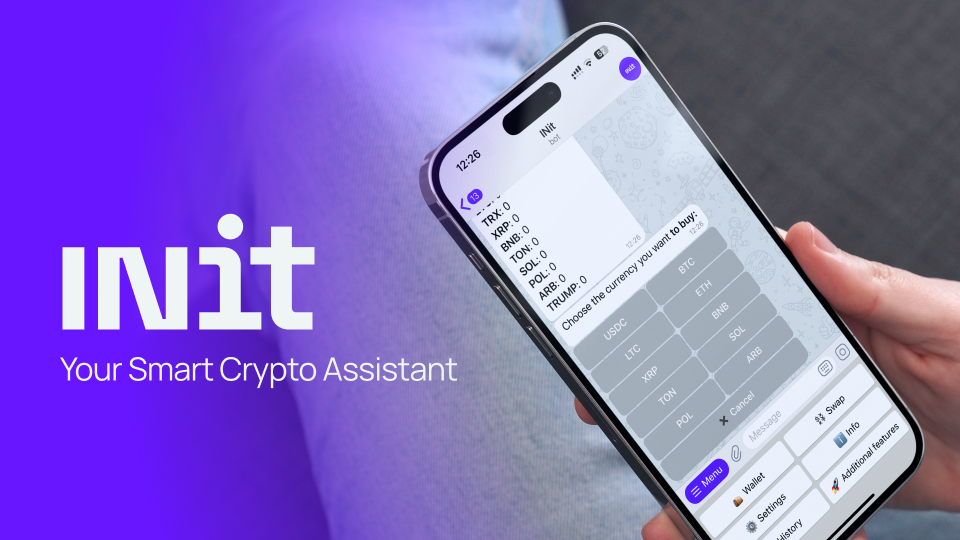
INit is built around making these choices easier to manage inside a familiar Telegram environment. The goal of a multi-currency future should not be to add complexity for users. It should be to give them more relevant options without forcing them to think about the infrastructure behind every transaction.
As new stablecoin markets develop, the most useful financial tools will be those that help users choose based on context — not habit.
Final Thought
Stablecoins made money easier to move globally. Now the market is discovering that global movement does not remove local needs.
Businesses still account in currencies. Customers still understand prices in currencies. Suppliers still issue invoices in currencies. And the most efficient payment is often the one that arrives already aligned with what happens next. EUR stablecoins remain tiny compared with their dollar-denominated counterparts. But their growth is revealing a larger shift.
The next phase of stablecoin adoption may not be about finding one digital currency for everyone. It may be about giving each payment the right currency for the job.