A person opens an account on a crypto exchange and completes identity verification. They upload a passport, take a selfie, confirm personal details, and wait for approval. A few weeks later, they join another financial platform and repeat the same process. Then a wallet asks for verification. An OTC service asks again. A payment provider asks again. A business platform asks for the same identity documents one more time.
From the user’s perspective, something feels inefficient: their identity has already been verified several times, yet every new financial relationship begins as if nothing is known. This repeated cycle has become one of the less visible friction points in digital finance. KYC remains essential for regulated financial services, but the way verified identity moves between products is starting to change.
The emerging idea is KYC portability: allowing verified identity data, credentials, or attributes to be reused across services with the user’s consent, while each platform continues to apply its own compliance requirements.
For crypto, where people routinely interact with multiple exchanges, wallets, payment tools, OTC providers, and business platforms, this could significantly change onboarding.
The Problem With Starting From Zero
Traditional KYC was designed around a relationship between one institution and one customer. A bank verifies a customer because the bank needs to know who it is serving. The collected information belongs to that compliance process, and another institution performs its own checks when the same person opens another account.
That model becomes increasingly repetitive in digital finance. A crypto user can interact with several financial services in a single month. Each service may request similar information: identity document, date of birth, address, facial verification, or proof of residency.
The user experiences this as repetition. The company experiences it as onboarding cost. Every additional step creates another point where a potential customer can stop. Documents may need to be uploaded again, cameras may fail, information may be entered differently, or a user may simply decide that accessing the service is not worth another verification process.
This creates an unusual situation: financial platforms spend resources verifying people whose identity may already have been checked by another trusted provider only days earlier.
The underlying problem is fragmentation. Verified identity remains attached to individual onboarding sessions rather than travelling easily with the user.
What Portable KYC Could Actually Mean
KYC portability does not require every platform to accept a universal “verified” badge without further checks. A more practical model separates verified identity data from the compliance decision made by each service. A user might verify core identity information once through a trusted identity provider. Later, another service could receive selected verified attributes with the user’s permission.
The new platform could then apply its own rules. It may need to check whether the document type is accepted in that jurisdiction, run sanctions and PEP screening, apply geographic restrictions, evaluate the customer’s risk level, or request additional information for a higher-risk product.
This creates a more efficient division of work. The identity document does not need to be uploaded from scratch every time. The compliance team still decides whether the customer meets the platform’s requirements.
Sumsub already describes this model through its reusable identity products. Its Sumsub ID allows users to store verified identity information and reuse it across participating services, while each receiving company still performs the checks required by its own policies. In October 2026, Sumsub also launched a Reusable KYC Gateway with MiniPay, allowing users to reuse verified identity across regulated partners in the MiniPay ecosystem.
The important shift is clear: verification can become reusable while compliance remains contextual.
Identity Is Stable. Risk Is Dynamic.
This distinction becomes even more important when we separate identity from risk. A passport does not change every time a person opens a new financial app. Their name, date of birth, and identity document remain relatively stable.
Risk can change much faster.
A customer may begin using a higher-value financial product. Their transaction behaviour may change. A new sanctions designation may appear. A jurisdiction may introduce new requirements. A business account may require more information than a basic personal account.
This means modern KYC increasingly has two layers.
- The first establishes identity: who is this person?
- The second evaluates context: what level of access is appropriate for this person, for this service, at this moment?
That structure leads naturally toward risk-based access. A low-risk action may require only a verified identity and basic screening. Higher-value transfers, business services, or unusual transaction patterns may trigger additional checks. This creates a better experience because verification becomes proportional to the activity. Users can enter the ecosystem with a known identity, while financial services increase scrutiny when the risk actually justifies it.
The Shift From KYC Event to Trust Lifecycle
Historically, KYC has often been treated as an onboarding event.
A user arrives, completes verification, receives approval, and enters the product. Modern financial services increasingly need a longer view.
A customer relationship can last years. Documents expire. Behaviour changes. Regulations evolve. Fraud techniques become more sophisticated. A user who passed verification three years ago may need updated information today.
This is why identity verification is gradually moving toward a trust lifecycle. Reusable identity can make the beginning of that lifecycle easier. Continuous monitoring, transaction screening, periodic refreshes, and risk-based checks maintain confidence afterwards.
This approach is especially relevant to crypto because the transaction environment changes quickly. A verified user can still interact with high-risk addresses, unusual counterparties, or new markets. A mature compliance system therefore combines reusable identity with ongoing risk assessment.
The identity tells the platform who the user is. Transaction and behavioural context help determine what needs attention now.
Why This Matters Especially in Crypto
Crypto users often have more fragmented financial lives than traditional banking customers.
One person may use:
- a centralised exchange for liquidity,
- a self-custodial wallet for assets,
- a Telegram tool for payments,
- an OTC provider for larger conversions,
- another service for stablecoins,
- and a separate platform for business transactions.
Every connection can introduce another verification flow. The result creates friction exactly where crypto aims to be flexible and interoperable.
A reusable identity layer could make this ecosystem feel more connected. A user could establish trusted identity once and selectively reuse verified information across services that participate in compatible systems.
That would also make switching providers easier. Users would spend less time rebuilding their profile and more time evaluating the actual product: fees, functionality, supported assets, payment routes, support, or business features.
This changes competition in a healthy way. When identity friction falls, financial products have to compete more on the quality of the service itself.
Portability Also Changes the Data Problem
Repeated KYC creates another issue: duplicated sensitive data. When a person uploads the same passport and biometric information to multiple services, copies of highly sensitive information may exist across many organisations.
Each additional database creates another place that needs to be secured, governed, updated, and eventually deleted according to applicable rules. Reusable identity opens the door to a more selective model.
A service may need proof that a person is over 18 without needing every detail printed on the identity document. Another may need verified name and nationality. A regulated financial product may require a larger set of attributes.
The European Digital Identity Wallet is moving in this direction at a broader level. EU Member States are expected to make digital identity wallets available by the end of 2026, enabling citizens, residents, and businesses to store and share verified credentials with public and private services. The system is designed around user control and selective disclosure, allowing people to share the information required for a specific interaction.
This wider identity trend matters for financial services because it changes user expectations. People are gradually becoming accustomed to the idea that verified identity can belong to the user and travel with them, rather than being recreated inside every platform.
Reusable Identity Does Not Create Universal Access
Portability still has limits. Financial services operate under different licences, regulations, product rules, and risk appetites. A verification accepted for one product may be insufficient for another.
A retail exchange and an institutional OTC service may require different information. A low-value payment account and a business account may have different onboarding standards. Services operating in different jurisdictions may accept different documents or apply different restrictions.
Reusable identity therefore works best as a foundation.
It can remove repeated collection of information that has already been reliably verified. The receiving company can then add the checks required for its specific relationship with the customer. This creates a more realistic future than one universal KYC approval that works everywhere.
The portable element is trusted information. The final compliance decision remains with the service providing access.
What Risk-Based Access Could Look Like
The combination of reusable identity and contextual checks can make financial onboarding more intelligent.
- A verified customer opening a basic payment feature could receive access quickly using previously confirmed identity information.
- The same customer requesting a higher transaction limit could be asked for additional information.
- A business account could trigger corporate verification and beneficial ownership checks.
- A high-risk transaction could require enhanced due diligence even when the user’s identity is already known.
This produces a layered experience:
| Situation | Possible Verification Approach |
|---|---|
| Existing verified user enters a new supported service | Reuse verified identity data |
| Basic low-risk functionality | Core identity + standard screening |
| Higher transaction limits | Additional verification or source-of-funds information |
| Business account | Company and ownership verification |
| Higher-risk transaction | Enhanced transaction and counterparty checks |
| Expired or outdated credentials | Targeted identity refresh |
The advantage is precision. The product asks for more information when more information is relevant.
The Business Case for Portable KYC
For companies, repeated verification has a direct cost. Every abandoned KYC flow represents a user who reached the product but never became an active customer. Every manual review consumes compliance resources. Every repeated document upload creates additional data-handling responsibility.
Reusable identity can improve this equation.
Sumsub reported in October 2026 that partners using its reusable KYC approach within MiniPay’s network had seen verification conversion increase from approximately 70% to 95%, while KYC completion time fell by up to 50%. These figures come from one implementation and should not be treated as universal benchmarks, but they illustrate the commercial value of reducing repetitive verification.
There is also an infrastructure benefit.
A platform that can rely on trusted verified data may need to collect and store less sensitive information itself, depending on the implementation and regulatory requirements. This makes KYC portability relevant to product teams, compliance teams, privacy teams, and growth teams at the same time. A smoother identity layer can improve the entire onboarding economics.
Where INit Fits Into This Evolution
INit already uses Sumsub for identity verification, placing it within an ecosystem that is actively developing reusable KYC infrastructure.
For users, the immediate value of verification inside INit is practical. Verified users receive their first three AML checks for free, giving them a tool they can use to evaluate wallet or transaction risk.
This is a useful product principle: verification should create visible value inside the experience. A user completes KYC and gains access to additional functionality that supports safer, more informed crypto activity.
As reusable identity systems develop further, products like INit can benefit from an environment where identity verification becomes easier to carry across financial services while AML/KYT, transaction checks, and risk-based controls remain close to the actual financial activity.
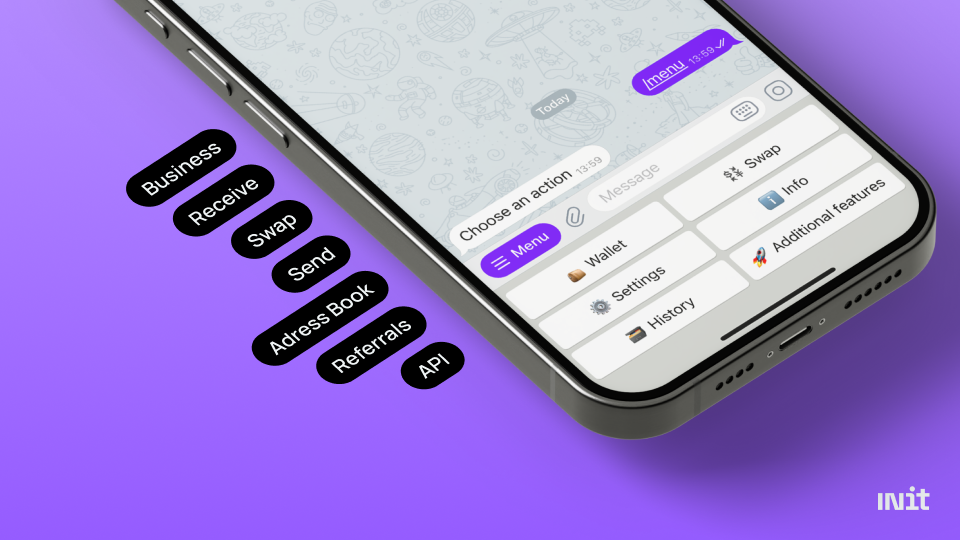
This fits naturally with INit’s wider approach. Users can access crypto tools through Telegram, perform AML checks, manage transactions, view history, and receive support in one environment. Businesses can add API-based workflows and more structured operational processes.
A portable identity layer would make that experience even more continuous because the user’s trusted context could travel with them instead of being rebuilt every time they enter a new part of the financial ecosystem.
From Repeated Verification to Reusable Trust
The digital finance industry is gradually separating two things that used to happen in one onboarding flow: establishing identity and deciding access.
That creates room for a much better model.
Identity can become reusable. Users can control which verified attributes they share. Platforms can apply their own risk policies. Higher-risk actions can trigger stronger checks. Monitoring can continue throughout the customer relationship.
Europe’s Digital Identity Wallet initiative points in the same general direction at a much larger scale. Sumsub and other identity providers are already experimenting with reusable KYC in commercial financial ecosystems. Crypto provides a particularly strong use case because users naturally move between many services.
The result could be a financial internet where proving who you are becomes less repetitive while compliance becomes more precise.
Final Thought
Users have spent years proving the same identity to different financial products. That experience is beginning to look outdated.
The next generation of KYC can allow verified identity to move with the user, while each financial service applies the checks appropriate to its own product, jurisdiction, and risk level. This creates a more useful balance between convenience and compliance. Users repeat fewer steps. Businesses reduce onboarding friction. Compliance teams focus additional scrutiny where the risk actually requires it.
For crypto, the impact could be particularly important. A financial ecosystem built around portable assets increasingly needs an identity layer that can become portable too.