Subscriptions changed the way people pay for digital products.
Music, movies, cloud storage, software, education, productivity tools, premium communities — all of them moved from one-time purchases to recurring access. Instead of buying a product once, users now pay continuously for availability, convenience, and an ongoing relationship with a service.
This model reshaped entire industries. Netflix changed how people consume entertainment. Spotify changed how people access music. SaaS changed how companies buy software. The subscription economy turned payments into background infrastructure: predictable for businesses, simple for users, and deeply connected to daily habits.
Crypto, however, has not fully found its subscription model yet.
Despite being digital, global, and programmable, crypto payments still behave mostly like one-time actions. A user opens a wallet, confirms a transaction, approves the amount, pays the fee, and waits for confirmation. That works well for transfers, swaps, deposits, and settlements. But it does not yet feel natural for recurring payments.
And that creates an interesting question:
If subscriptions became one of the dominant business models of the internet, why has crypto not made recurring payments feel simple yet?
Why Subscriptions Became So Powerful
The success of subscriptions is not only about monthly billing. It is about reducing decision-making. A subscription removes the need to purchase the same thing again and again. Once the user trusts the product, payment becomes automatic. The relationship continues until the user decides otherwise.
For businesses, this model creates predictable revenue. Instead of depending only on one-time purchases, companies can forecast income, understand retention, and build long-term customer relationships.
For users, the value is convenience. They do not want to manually pay for music every week, renew cloud storage every few days, or approve access to a work tool every month. They want the service to continue working.
That is the foundation of the subscription economy:
payment becomes invisible because trust has already been established.
Crypto has the infrastructure to move value globally, but recurring payment trust is more complex than simple transaction execution.
Why Crypto Payments Are Still Mostly Manual
Most crypto payments today are designed around direct user control. This is one of crypto’s strengths. Users approve transactions themselves, hold their own assets, and can see what is happening on-chain. But the same structure makes recurring payments harder.
In traditional finance, recurring billing is built around cards, bank mandates, and payment processors. A user gives permission once, and the provider can charge them later according to agreed terms.
In crypto, this is more difficult because transactions are usually irreversible and wallet permissions can be risky if poorly designed. Users are cautious about granting automated access to their funds, and for good reason.
A recurring crypto payment system must solve several problems at once:
- user consent,
- spending limits,
- cancellation,
- failed payments,
- price volatility,
- gas fees,
- refunds,
- and clear payment history.
A normal subscription feels simple because much of this complexity is hidden by banks and payment processors. In crypto, the infrastructure is more transparent, but that also means the product must explain more clearly what the user is approving.
The Real Challenge Is Not Technology Alone
Technically, recurring crypto payments are possible. Smart contracts can schedule logic. Wallet permissions can authorize spending. Stablecoins can reduce volatility. Bots and apps can trigger payment reminders or automate flows.
The harder challenge is product design.
A good subscription experience must answer questions before the user even asks them:
What exactly am I approving?
How often will I be charged?
Can the amount change?
Can I cancel instantly?
What happens if there are not enough funds?
Where can I see the payment history?
How do I know the contract or service will not take more than expected?
In traditional subscriptions, users often trust the brand or payment provider. In crypto, they must also trust the smart contract, wallet interaction, and transaction logic. That is why recurring crypto payments cannot simply copy the card subscription model. They need their own structure.
From Automatic Charges to User-Controlled Automation
The future of crypto subscriptions will likely be built around controlled automation rather than unlimited access. This means users may approve payment rules, not open-ended permissions.
For example:
- charge no more than a fixed amount,
- only charge once per billing period,
- use a specific token,
- send reminders before payment,
- allow instant cancellation,
- show a clear payment log.
This is a major difference from traditional recurring billing. Crypto can give users more control over automation, but that control must be easy to understand. If the interface feels too technical, recurring payments will remain niche. If it becomes too abstract, users may not trust it.
The right model sits between both extremes: automated enough to be convenient, transparent enough to feel safe.
How Recurring Payments Could Work in Crypto
Recurring crypto payments will not be useful only for streaming or media subscriptions. Their strongest use cases may appear in digital-first ecosystems where users already hold crypto or stablecoins.
| Use Case | Why Crypto Could Fit | Main Requirement |
|---|---|---|
| SaaS subscriptions | Global customers can pay without card limitations | Stablecoin billing and clear invoices |
| Creator memberships | Communities can collect recurring support directly | Easy cancellation and transparent access rules |
| Telegram channel subscriptions | Users already interact inside chats and bots | Simple payment flows within Telegram |
| Freelancer retainers | Clients can fund recurring work agreements | Predictable schedules and payment records |
| Web3 tools and services | Users already manage wallets and digital assets | Wallet-native billing with spending limits |
| Business API access | Companies can pay for usage-based services | Reporting, invoices, and integration logic |
The common theme is not “crypto replacing cards everywhere.” The stronger argument is that crypto can serve environments where traditional payment systems create friction: global access, cross-border users, digital communities, and programmable financial relationships.
Why Stablecoins Matter for Subscription Payments
Volatility is one of the biggest barriers to crypto subscriptions. A monthly subscription priced in a volatile asset can become confusing for both sides. The customer may not know the real cost, and the business may not know the real revenue.
Stablecoins solve part of this problem by making crypto payments more predictable.
For businesses, stablecoin subscriptions could make international billing easier. A company can charge users globally without relying on every local card network or banking provider. For users, stablecoins can make payments feel closer to familiar fiat pricing while still using crypto rails.
This is especially relevant for digital products with international audiences.
A creator, SaaS platform, or Telegram-based service may have users from different regions. Instead of managing many local payment methods, stablecoin billing can offer one global settlement layer.
But stablecoins alone are not enough. The product still needs recurring logic, clean UX, payment reminders, receipts, and dispute handling.
Telegram as a Natural Environment for Crypto Subscriptions
Telegram is one of the most interesting places where crypto subscriptions could develop. The reason is simple: Telegram already combines communities, content, bots, channels, and payments-like behavior inside one environment.
A user may follow a channel, join a private group, interact with a bot, receive updates, and manage digital tools without leaving the app. This makes Telegram a natural home for subscription-based crypto products.
Possible examples include:
- paid private communities,
- premium trading or analytics channels,
- recurring access to tools,
- creator memberships,
- business bot subscriptions,
- usage-based service payments.
The opportunity is not just about charging users automatically. It is connecting recurring payments to access. A subscription should not be a separate financial action. It should unlock something directly: a channel, a tool, a dashboard, a service, or a business feature.
Telegram makes this relationship easier to understand because the product and community experiences occur in the same place.
Why Crypto Has Not Found Its “Netflix Moment” Yet
Crypto subscriptions have not reached mainstream adoption because the experience is still fragmented.
Users may need to connect wallets, approve contracts, manage gas, hold the right token, track permissions, and understand technical risks. That is too much friction for something that should feel simple.
The subscription economy succeeds when payment disappears into the background. Crypto still often brings payment into the foreground. That is not necessarily bad. In finance, visibility matters. But recurring payments require a careful balance between convenience and control.
Crypto’s “Netflix moment” will not come from copying Netflix billing. It will come when a user can subscribe to a crypto-powered service with the same ease as a regular subscription, while still keeping the transparency and control that make crypto valuable.
That means the winning model must feel familiar on the surface and crypto-native underneath.
Where INit Fits Into This Shift
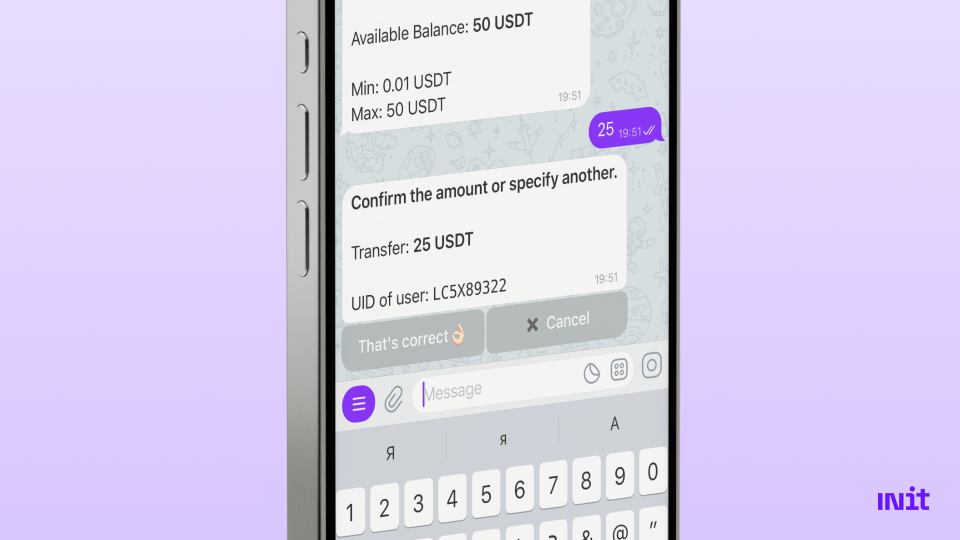
For recurring crypto payments to become practical, users and businesses need tools that make crypto operations easier to access and manage. This is where INit fits into the broader direction of Telegram-native financial infrastructure.
INit is built around the idea that crypto actions should be simple, accessible, and integrated into familiar user behavior. Through Telegram, users can interact with crypto tools in an environment they already understand, without turning every action into a complicated technical process.
For businesses, this direction is especially important. As more financial flows move into bots, APIs, and digital-first interfaces, companies need solutions that can support payment activity, transparent transaction flows, AML checks, and operational integration.
Subscription payments are not only about charging users every month. They require trust, clarity, repeatable flows, and reliable infrastructure. Tools like INit help bring crypto closer to that everyday operational layer.
The Future: Subscriptions, But More Programmable
The next stage of the subscription economy may not look exactly like today’s card-based model.
Crypto could introduce more flexible versions of recurring payments:
- subscriptions with spending limits,
- usage-based crypto billing,
- token-based memberships,
- automatic stablecoin settlements,
- programmable access to digital services,
- community subscriptions inside messaging apps.
This would make subscriptions more adaptable. Instead of one standard monthly charge, users and businesses could create payment relationships that match the way digital services are actually used.
The future is not just “Netflix paid with crypto.” It is a broader shift toward programmable financial relationships.
Final Thought
Subscriptions changed the internet by making access continuous. Crypto could change subscriptions by making payments programmable, global, and more user-controlled.
But for that to happen, the experience must become simpler. Recurring crypto payments need more than smart contracts. They need trust, clear permissions, stable pricing, easy cancellation, transparent records, and interfaces that feel natural.
The subscription economy taught users to expect convenience. Crypto now has to prove that automation can be convenient without giving up control.