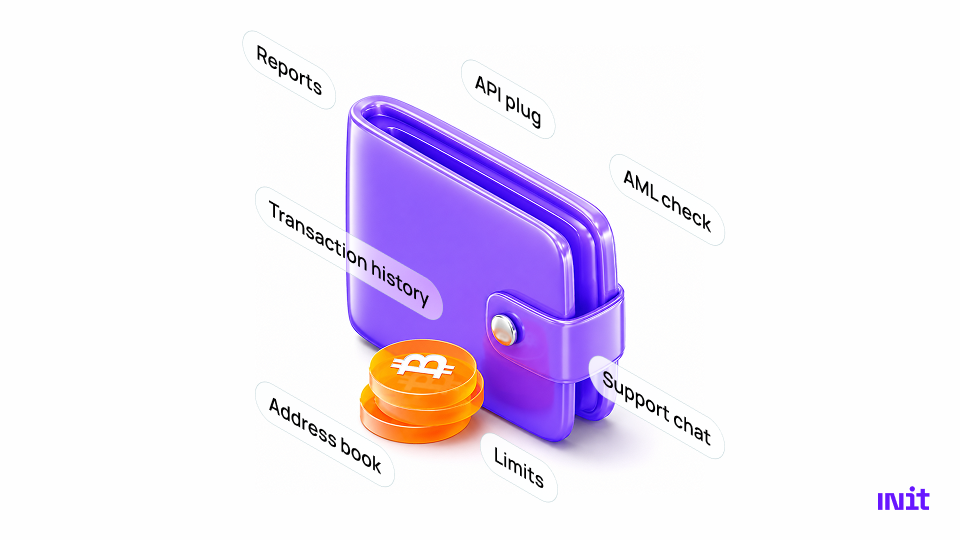
A crypto wallet can hold assets, receive funds, and send them somewhere else. For an individual user, that may be enough.
For a business, it rarely is. The moment crypto becomes part of daily operations, the question changes. A company no longer asks only:
“Where are the funds?”
It also needs to know:
Who can access them?
Who is allowed to approve a payment?
Has the counterparty been checked?
What fee was paid?
Where is the transaction record?
How does this connect to the rest of the business?
These are not wallet questions. They are operational questions.
That is why the next stage of B2B crypto is not simply about better wallets. It is about the emergence of the business crypto account: a financial workspace that combines payments, controls, records, compliance tools, integrations, and support around the movement of digital assets.
A Wallet Was Designed Around Ownership
The core logic of a crypto wallet is simple. It shows assets associated with an address and gives the holder the ability to sign transactions. This model works remarkably well for personal ownership. One person controls the wallet, decides when to transact, and keeps track of activity.
A company operates differently.
Business money belongs to an organization, but different people interact with it for different reasons. A finance employee may prepare a transaction. A manager may approve it. An accountant may need the history. A developer may connect payments to another system. A compliance specialist may need to review a counterparty. The payment is no longer a single action by a single person.
It becomes a workflow.
This is the first major difference between a crypto wallet and a business payment account: a wallet manages access to assets; a business account manages the process around them.
The Moment Crypto Becomes an Operational Tool
Imagine a company receives one crypto payment per month. A standard wallet can probably handle that.
Now imagine the same company:
- receives payments from international clients,
- pays multiple contractors,
- works with several currencies,
- checks counterparties,
- needs records for accounting,
- and wants payment data connected to its internal platform.
The blockchain transaction has not necessarily become more complicated. The business context has. The company needs a repeatable process from the moment funds arrive to the moment the operation is recorded.
A typical flow may look like this: Receive → identify → check → approve → send → confirm → record → reconcile
The wallet handles only part of that sequence. Everything around it is often managed through spreadsheets, chat messages, screenshots, blockchain explorers, separate compliance platforms, and manual confirmations. That gap is where the business payment account begins to make sense.
Storage and Operations Are Different Products
A useful business crypto product should not simply add more buttons to a wallet. It should solve a different set of problems.
| Traditional Crypto Wallet | Business Payment Account |
|---|---|
| Holds assets | Supports financial workflows |
| One user controls actions | Different access and approval needs |
| Shows transactions | Organises operational history |
| Sends to an address | Manages repeatable payment flows |
| Manual actions | API-enabled integrations |
| Basic balance visibility | Reporting and reconciliation context |
| Separate compliance checks | AML tools closer to the transaction flow |
| User solves exceptions alone | Support for operational issues |
The difference is not cosmetic. A business payment account treats a transaction as part of a larger system. That matters because companies do not measure financial infrastructure by whether one payment can be completed. They measure it by whether hundreds or thousands of payments can be managed consistently.
Businesses Need Roles, Not Shared Passwords
One of the clearest signs that a wallet is becoming business infrastructure is the need to separate responsibilities. The person preparing a payment should not always be the same person who gives final approval. A finance employee may need operational access without full control. A developer may need API permissions without access to every account function.
Traditional business finance already works this way. Crypto operations are moving in the same direction.
Modern institutional digital-asset platforms increasingly support structures such as role-based access, approval groups, transaction policies, and different permissions for API users. The reason is practical: organizations need to define not only whether a transaction is technically possible, but whether it fits internal rules.
For businesses, control is not one switch between “access” and “no access.” It is a set of responsibilities. This is a fundamental shift away from the personal wallet model.
Transaction History Must Become Business Memory
Blockchains already create transaction records. But raw data is not the same as usable business history.
An accountant does not want to reconstruct a payment from a long hash. A finance manager does not want to search across multiple wallets to understand what happened last month. A support team should not need screenshots to identify a transaction.
Business users need history that answers practical questions:
What happened?
When?
For how much?
With which counterparty?
What was the status?
What did it cost?
Who initiated the action?
This is why transaction history becomes more valuable as crypto use grows. A personal user may want to remember a transfer. A business needs to reconcile it.
The difference sounds small, but it changes the product requirement completely. Records need to be searchable, understandable, and usable outside the original moment of payment.
AML Checks Belong Closer to the Payment Decision
For a company, checking risk after a transaction is often less useful than understanding it before funds move. This is why AML and counterparty screening are becoming part of the operational layer around business crypto payments. The point is not to turn every finance employee into a compliance analyst. It is the opposite. Good business infrastructure should make relevant checks accessible at the moment they are needed.
A payment workflow should allow the company to answer a basic question before continuing: Do we understand who we are transacting with and the risk connected to this address?
As crypto payments scale, this becomes part of normal transaction hygiene.
The most useful model is not a wallet on one side and a completely disconnected compliance process on the other. It is a workflow where the business can check, decide, transact, and keep the relevant record with less fragmentation.
Why the API Is Not an Extra Feature
A consumer can open an app and make a transaction manually. A business cannot build serious payment operations around someone repeating the same clicks all day. This is why API access becomes one of the dividing lines between a crypto tool and business infrastructure.
An API allows payment functionality to connect with the company’s existing systems.
Depending on the use case, that can mean:
- initiating payment flows,
- retrieving transaction information,
- checking statuses,
- connecting customer actions to backend processes,
- automating repeatable operations,
- or bringing payment data into internal dashboards.
The important point is not automation for its own sake. It is continuity. Without integration, crypto remains a separate tool that employees have to manage manually.
With integration, it can become part of the company’s actual product and operations. That is when a crypto account stops being somewhere the business visits and starts becoming infrastructure the business uses.
A Business Account Also Has to Handle Exceptions
The perfect payment flow gets most of the attention. But businesses are often defined by what happens when the perfect flow breaks.
A payment status is unclear.
A counterparty changes details.
A transfer requires additional context.
An integration behaves unexpectedly.
A team needs to understand what happened quickly.
Consumer products can sometimes push users toward a help center and expect them to figure out the rest. Business finance has a lower tolerance for ambiguity. When money is part of operations, unresolved questions can delay suppliers, customers, payroll, or internal processes.
That is why support is not separate from the product. For business users, it is part of the infrastructure. A good payment account combines self-service tools for normal operations with access to real help when an exception requires context.
The Business Payment Account Is a Layer, Not Just an Account
It would be easy to think of this evolution as a simple product upgrade: wallet → more advanced wallet → business wallet.
But the larger shift is different. The business payment account is becoming a layer between blockchain infrastructure and company operations.
On one side are:
- networks,
- assets,
- addresses,
- and transactions.
On the other are:
- employees,
- clients,
- accounting,
- compliance,
- internal systems,
- and business rules.
The value of the account is in connecting both sides. The business should not need to rebuild its entire operation around blockchain mechanics. The financial tool should translate those mechanics into workflows that fit the organization.
That is the real opportunity in B2B crypto.
Where INit Fits Into This Shift
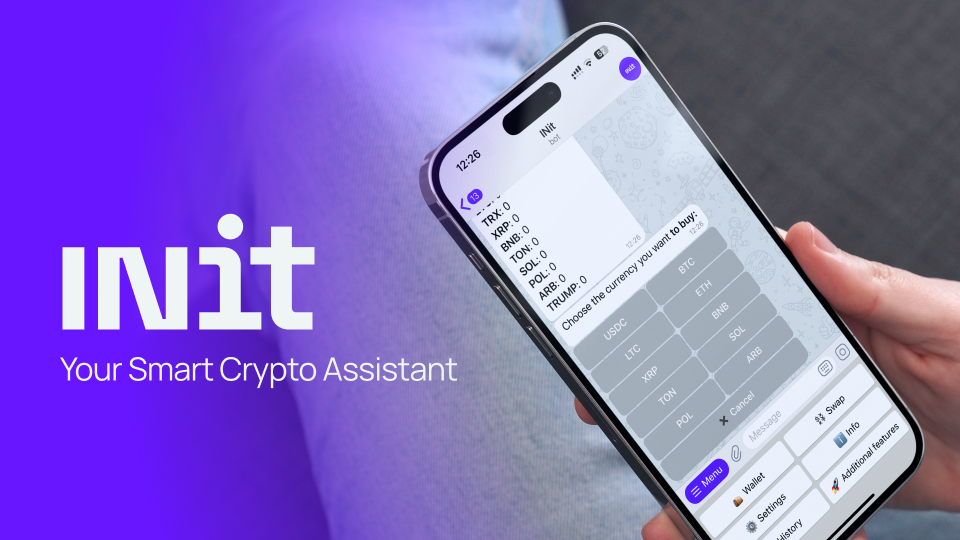
INit is designed for both individual and business crypto use, but the needs of these audiences are different. A regular user may primarily value simplicity, speed, transparent fees, and an accessible way to manage crypto operations inside Telegram.
A business needs another layer.
INit’s B2B direction is built around practical business requirements such as payment flows, API support, AML checks, operational clarity, and access to support. Its multi-currency approach also reflects the reality that companies may need to work across different fiat currencies and crypto pairs rather than follow one universal payment route.
- The API is particularly important here. It allows businesses to connect crypto functionality with their own products and internal systems instead of treating every transaction as a separate manual action.
- AML checks add another practical layer by allowing counterparties and transactions to be evaluated closer to the payment process.
- Transparent fee information helps businesses understand the real cost of an operation before it becomes an accounting surprise.
And because INit works through Telegram, these tools remain accessible in an environment users already know rather than requiring another complex financial dashboard for every action. The goal is not to make a crypto wallet look more corporate. It is to make crypto easier to use as part of real business operations.
Final Thought
A wallet answers a technical question: Where are the assets?
A business payment account answers a much larger one: How does money move through the organization?
That includes who can act, what needs to be checked, how a transaction is approved, where the record goes, and how the process connects to the rest of the business. As crypto becomes part of payments rather than simply a portfolio, this operational layer will matter more.
The future of B2B crypto may not look like a better wallet. It may look like a financial workspace built around the way businesses actually move money.