For many businesses entering crypto, AML checks initially feel like a regulatory formality.
Something required by compliance teams.
Something connected to rules, restrictions, or legal obligations.
Something that slows transactions down.
But that perception is changing.
As crypto becomes part of real operational finance, businesses are starting to view AML checks differently — not as an obstacle, but as a form of protection. Because in practice, the cost of sending funds to the wrong counterparty can be far greater than the cost of checking first.
The Problem Is No Longer Technical
In the early days of crypto, most business concerns focused on technology itself:
- wallet security,
- transaction speed,
- exchange reliability,
- custody risks.
Today, the infrastructure is significantly more mature.
The bigger challenge increasingly lies elsewhere: understanding who you are transacting with.
Unlike traditional banking systems, crypto transactions are highly accessible and global. Funds can move instantly between parties that may never interact directly beyond a wallet address. This creates enormous efficiency — but also introduces new operational risks.
A wallet address reveals almost nothing at first glance:
- who controls it,
- where funds originated,
- whether the assets interacted with illicit activity,
- or whether the address has been flagged previously.
And once a transaction is executed, reversing it is often impossible.
Why Businesses Cannot Afford Blind Transfers
For individual users, a risky transaction may create inconvenience.
For businesses, it can create:
- financial exposure,
- compliance complications,
- operational disruptions,
- reputational damage,
- or banking relationship issues.
The key difference is scale.
Businesses process:
- recurring payments,
- contractor settlements,
- partner transfers,
- treasury operations,
- and cross-border transactions.
Over time, even a small percentage of risky counterparties can become a serious operational liability. This is why AML screening is increasingly becoming part of financial due diligence rather than simply regulatory compliance.
The question shifts from: “Are we required to check?”
to: “Why would we send funds without checking first?”
The Hidden Cost of Risky Counterparties
One of the most misunderstood aspects of crypto risk is that problems often appear after the transaction.
For example:
- an exchange may later freeze funds,
- a payment provider may request explanations,
- a banking partner may flag incoming transfers,
- or internal finance teams may struggle to justify transaction origins.
In these situations, the issue is not the transfer itself. It is the transaction history connected to the counterparty. Crypto creates permanent financial trails. That means every transaction carries context beyond the immediate payment.
This changes how businesses think about operational risk.
AML Checks as Operational Intelligence
Modern AML tools do far more than identify “bad wallets.”
They provide contextual intelligence:
- exposure to sanctioned entities,
- connections to stolen funds,
- darknet activity,
- mixer usage,
- fraud indicators,
- suspicious transaction patterns.
For businesses, this transforms AML checks into a decision-making tool. Instead of blindly executing transfers, companies gain visibility into potential risk before money moves.
This is particularly valuable in environments involving:
- international contractors,
- large settlements,
- OTC operations,
- treasury management,
- or high-volume payment flows.
The goal is not paranoia.
It is informed decision-making.
The Difference Between Basic and Operational AML Usage
Not all AML usage looks the same.
Some businesses approach it minimally:
- occasional manual checks,
- fragmented workflows,
- no structured records.
Others integrate AML into operational processes directly.
| Minimal AML Usage | Operational AML Workflow |
|---|---|
| Reactive checks | Preventive screening |
| Manual verification | Structured processes |
| One-time review | Ongoing monitoring |
| Limited documentation | Reportable records |
| Compliance-focused | Risk-management focused |
The second model scales far more effectively as transaction volume increases.
Where INit Fits Into This Approach
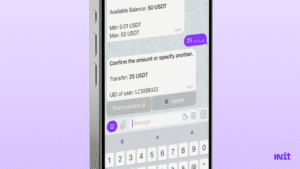
This practical approach is reflected in how INit integrates AML functionality into the product experience. Users can perform AML checks directly within INit, making it easier to evaluate counterparties before sending funds or accepting transfers.
To make the process more accessible, AML checks can be purchased in convenient packages at more efficient pricing for regular use. In addition, new users receive their first 3 AML checks for free, allowing them to explore the feature and better understand transaction risk before committing to larger operations.
The goal is to make AML checks simple, practical, and usable in everyday financial workflows — rather than something complex or disconnected from real operations.

The Future of Business Crypto Operations
As crypto becomes more integrated into global financial workflows, operational standards will continue rising. Businesses will increasingly be expected to:
- understand transaction exposure,
- verify counterparties,
- document payment activity,
- and demonstrate risk awareness.
In this environment, AML checks stop being “extra features.” They become part of normal financial hygiene. Just like companies verify invoices, suppliers, and banking details today, crypto counterparties will increasingly be screened before transactions are approved.
Final Thought
The most expensive crypto mistakes are often preventable.
Not through faster transactions.
Not through more automation.
But through better visibility before money moves.
That is the real business case for AML checks. Because in operational finance, the smartest risk is the one avoided before it happens.