Many businesses start using crypto in the simplest possible way.
Someone copies a wallet address.
Someone sends a screenshot.
Someone checks the transaction hash.
Someone updates a spreadsheet.
Someone confirms the payment in a chat.
At the beginning, this can work. If a company processes one or two crypto payments a month, manual operations may feel manageable. The team knows each transaction, remembers the context, and can quickly check details when needed.
But manual crypto operations do not scale well. The more transactions a business handles, the more fragile this system becomes. What looked simple at low volume starts creating operational risk: wrong addresses, duplicate payments, missing records, unclear statuses, inconsistent checks, and human error.
The problem is not that crypto is difficult to use. The problem is that businesses often try to manage crypto with tools that were never designed for business workflows.
Manual Work Feels Flexible Until It Becomes a Risk
Manual crypto operations usually begin for a practical reason. A company wants to move quickly. It does not want to build a full integration, create internal processes, or connect a dedicated payment tool before testing crypto payments.
So the team uses what is available:
- spreadsheets,
- screenshots,
- chat confirmations,
- copied wallet addresses,
- blockchain explorers,
- manual AML checks,
- and informal approval flows.
This approach gives speed at the beginning. But it also creates dependency on individual attention. Every transaction depends on someone copying correctly, checking carefully, saving the right record, and remembering the context later.
That is not a system. It is a habit. And habits become risky when transaction volume grows.
The Address Problem
Crypto addresses are not designed for human memory. They are long, technical strings where one wrong character can change the destination completely. For individual users, this is already stressful. For businesses, the risk grows because multiple people may handle the same process.
A finance team may copy an address from a chat. A manager may approve it in a separate message. A record may be saved in a spreadsheet. Later, someone else may need to use the same address again.
At every step, the business relies on manual accuracy. This is why saved recipients and address books matter. They reduce repeated copying and create a more controlled way to manage counterparties. The goal is simple: businesses should not have to rebuild trust in the same address every time they make a payment.
Spreadsheets Are Not Payment Infrastructure
Spreadsheets are useful for many things. But they are not designed to be the main operational layer for crypto payments.
When teams track transactions manually, records can quickly become inconsistent. One person may save the transaction hash. Another may save only the amount. Someone may forget to update the status. A duplicate row may appear. A payment may be marked as completed before it is fully confirmed.
The blockchain may contain the transaction, but the business still needs usable internal records.
A raw transaction hash is not enough for daily operations. Finance teams need context: who the payment was for, what amount was sent, what fee applied, whether the counterparty was checked, and what status the payment reached. Without a structured history, the company eventually spends more time reconstructing transactions than managing them.
The Hidden Cost of Screenshots
Screenshots are one of the most common signs of manual crypto operations. They feel convenient because they create quick proof that something happened. But they are weak as an operational record.
A screenshot can show a status at one moment, but it does not update. It can be lost in a chat. It may not include all relevant information. It is difficult to search, export, connect to accounting, or use in reporting.
For small teams, screenshots may feel harmless. For businesses, they create fragmented memory. The company may have proof somewhere, but not in a form that is easy to use later. A mature crypto workflow should not depend on searching through old messages to understand what happened to company funds.
When Status Becomes Unclear
A crypto transaction usually passes through several states: created, pending, confirmed, completed, failed, or requiring further action.
In manual workflows, these statuses are often tracked informally.
Someone says “sent.”
Someone else says “received.”
Another person checks the explorer.
A fourth person updates the spreadsheet later.
This creates confusion. If a payment is delayed, the team may not know whether the issue is with the network, the address, the provider, the internal record, or the recipient. If there is no shared transaction history, the status becomes a conversation instead of a fact.
Clear status visibility is not just a UX feature. For businesses, it reduces unnecessary messages, prevents duplicate actions, and makes payment operations easier to manage.
Manual AML Checks Create Gaps
AML checks are another area where manual operations can become inconsistent. A business may check some counterparties but not others. It may perform checks only for large payments. It may save reports in different places. It may not connect the result to the transaction record.
This creates gaps in the process. The question is not only whether the check was performed. It is whether the business can prove later what was checked, when, and why the payment was approved. As crypto payments become more operational, AML checks need to sit closer to the transaction flow. They should not feel like a separate task that depends entirely on someone remembering to do it.
This is especially important for businesses that work with recurring counterparties, large transfers, or international payments.
The API Gap
At some point, every growing business faces the same question: Why are we still doing this manually?
Manual payment flows may be acceptable for testing. They are not suitable for repeated operations. Without API access, crypto remains disconnected from the business system. Employees have to create payments manually, check statuses manually, copy records manually, and update internal tools manually.
This creates more work and more risk. An API changes the role of crypto inside the company. It allows payment actions, transaction data, and operational workflows to connect with internal systems. This matters because businesses do not want crypto to exist as a separate island. They need it to fit into the way they already operate.
Manual vs Structured Crypto Operations
| Manual Crypto Operations | Structured Crypto Operations |
|---|---|
| Addresses copied from chats | Saved recipients and address book |
| Screenshots used as proof | Transaction history and records |
| Status checked manually | Clear transaction status visibility |
| Payments created one by one | Multi-send and repeatable flows |
| AML checks handled separately | AML checks closer to the payment process |
| Data updated in spreadsheets | API-connected workflows |
| Support needed to reconstruct context | Support works with clearer transaction records |
The difference is not about making crypto more complicated. It is about removing unnecessary manual work from processes that businesses repeat often.
Where INit Fits Into This Shift
INit helps businesses move from manual crypto operations toward more structured flows.
Instead of relying only on copied addresses, screenshots, and spreadsheets, users can manage crypto actions inside a Telegram-native environment with tools designed for repeated use.
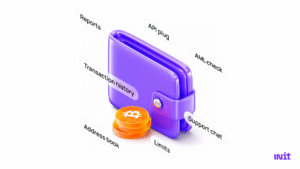
The address book helps save and reuse trusted recipients, reducing the need to copy wallet addresses every time. Transaction history gives users a clearer way to return to past activity. Multi-send supports payments to multiple recipients in one process, which is useful for businesses managing several payouts.
AML checks and AML packs make counterparty screening easier to access when checks are needed regularly. Support adds another practical layer for situations where the transaction context needs clarification.
For businesses, API access is especially important. It allows crypto functionality to connect with internal systems rather than staying as a manual side process.
Together, these tools help turn crypto from a set of individual actions into a more organised payment workflow.

Why This Matters for Business Adoption
Businesses do not adopt financial tools only because they are fast. They adopt them when they become reliable, repeatable, and easy to control.
Manual crypto operations may work at the beginning, but they create friction as soon as volume increases. The issue is not always visible immediately. It appears gradually: more messages, more checks, more screenshots, more uncertainty, more time spent reconstructing what happened.
That is why structured workflows matter.
They reduce the number of places where human error can enter the process.
They also make crypto easier to use across teams, not just by one person who understands every detail.
For business crypto adoption to grow, the industry needs fewer manual workarounds and more operational systems.
Final Thought
Manual crypto operations are not a failure. They are often the first step. But they should not become the long-term system.
A business cannot scale payments around copied addresses, screenshots, scattered chats, and disconnected spreadsheets. As crypto becomes part of real business workflows, companies need structure: saved recipients, transaction history, AML checks, multi-send, API access, and support.
The future of business crypto is not just about moving funds faster. It is about making the process reliable enough to repeat.